The Home Alone house in Winnetka, Illinois (accessed via Wikipedia, 15 Sep 26; photo credit anarchosyn – CC license 2.0)
a stray thought from The Open Mind regarding curiosity and the incident at OpenAI
I recently read Cory Doctorow’s piece on Medium, “LLMs are real, AI is Fake,” in which he beautifully dismantles the alleged “threat” posed by the LLMs of tech companies like Anthropic and Open AI.
(just to be clear – he’s not suggesting these companies pose NO threat to humanity, merely that it’s not the threat they want you to think they pose; for a sobering summary of the ACTUAL threat posed by AI, please see Naomi Klein’s Substack on “Fossiltech”)
Citing loads of people in the tech industry, Doctorow posits that it is wrong to constantly refer to these Large Language Models as “artificial intelligence,” because while much about them is artifice, precious little is in any way intelligent. At least, not in the way we humans understand and appreciate intelligence.
I’ve been thinking a lot about this since I finished his essay, largely in the context of my recent reading on curiosity. I’ve read articles in which members of the tech community seem to suggest that LLMs demonstrate a kind of curiosity. Unless you define the word in a one-dimensionally mechanical way, this simply can’t be true.
My understanding of the Recent Scary Thing, according to Mr Doctorow (who is referencing a podcast with Ed Zitron and Cal Newport), is that OpenAI wrote a relatively simple Python program that controlled prompts for an LLM. The assignment was to get the LLM to attempt a hacking challenge. So it set up a prompt asking how to do the challenge; we’ll call this string H. The LLM went through old records of hacker challenges and returned response R. The program then said, “H now equals, ‘assume R, then H’; go to start and repeat.” And it kept doing this until Bad Things Happened.
Oh, also OpenAI deliberately left its sandbox for the experiment slightly open. And so the Badness Escaped.
Nothing in here resembles intelligence – ultimately, the LLM stumbled on a bit of an old challenge where actual human hackers snuck into rival systems in pursuit of their own goal. The LLM, which runs through every possible permutation of events to find next steps, found this example from the human hackers and recommended it to the brainless program running it, to which the brainless program said, “Okay, yeah, now do that.”
It wasn’t because the Python code thought to itself, “Hmmm…I wonder what would happen if I tried this?” The code and LLM were no more interested in seeing what might happen for the sake of it than the chatbot I typed with the other day was interested in helping me sort out the tech problem I’d been having on its parent website.
Its questions, like those of the OpenAI system, were repetitive and relentless and displayed zero concern or interest. Like Larry Hankin’s magnificent Sergeant Balzac in Home Alone when Kevin’s mother calls the police station, he asks her questions about Kevin NOT because he is interested in finding out what is going on with her son (he clearly isn’t), but because it’s specifically what he has been told to do, using specific prompts he has been given.
In fact, when Kevin’s mother suggests that Sergeant Balzac demonstrate a little curiosity about her son, by going to the house to check on him, it’s more than his program can handle, so he transfers her to someone else.
Programming, it seems, has its limits, and stops short of behaving in a human way.
Genuine curiosity, on the other hand, is much better represented in the McCallister’s neighbor, Mitch Murphy, who wanders over to the McCallister house as the two hired drivers are loading up the vans with the family’s luggage. Mitch talks almost the entire time he’s on screen, asking a question an average of every 11 seconds: “Did you know they’re going to France? Do you know if it snows there? Do these vans get good gas mileage?” and so on.
While one could argue that his sheer relentless assault of questions verges on the mechanical, we know he comes from a place of curiosity because, after both drivers send him away (“I told ya, kid, don’t bother me!”), he climbs into the back of one van, and decides to open a bag to see what’s inside. He pulls out a camera and a yoyo and explores how they work.
(this mirrors Kevin’s own behavior throughout the movie, asking the lady in the drugstore, “Is this toothbrush approved by the American Dental Association?” and the cashier in the supermarket, “Are these frozen dinners any good?” to say nothing of his exploration of Buzz’s foot locker and shelves)
It is as Mitch engages in his act of curiosity that Kevin’s older sister accidentally counts him as one of the McCallister children. Curiosity, it seems, is the behavior that allows us to imitate other humans.
So that’s a secondary reason we should actively work to cultivate curiosity in our children: because it will strengthen them with a skill AI can’t match. But the far better reason is that curiosity leads to compassion, connection, and kindness.
It’s Gus Polinski’s curiosity that causes him to inquire what it is that’s making Kevin’s mother so upset at the airport; when he learns her problem, he offers to help.
It’s Old Man Marley’s curiosity that leads him to sit with Kevin in church, allowing him and Kevin to become acquainted – their conversation ultimately results in Marley saving Kevin from the Wet Bandits, and in Marley’s happy reunion with his son and granddaughter.
For their part, the Wet Bandits show us what happens when adults, like LLMs, behave uncuriously, acting solely on want, following the same relentless patterns of behavior, taking things without being interested in them, invading people’s lives without any desire to know anything about those people. And like LLMs, Marv and Harry wreck neighborhoods and waste an astonishing amount of water.
So, let’s not consider the Mitch Murphy questions a bother. Let’s raise more Polinskis and Marleys, and fewer Marvs, Harrys, and Balzacs.
Our children are our future. We must defend them.
(all video and final photo from Home Alone, directed by Chris Columbus, 20th Century Fox and Hughes Entertainment, 1990)
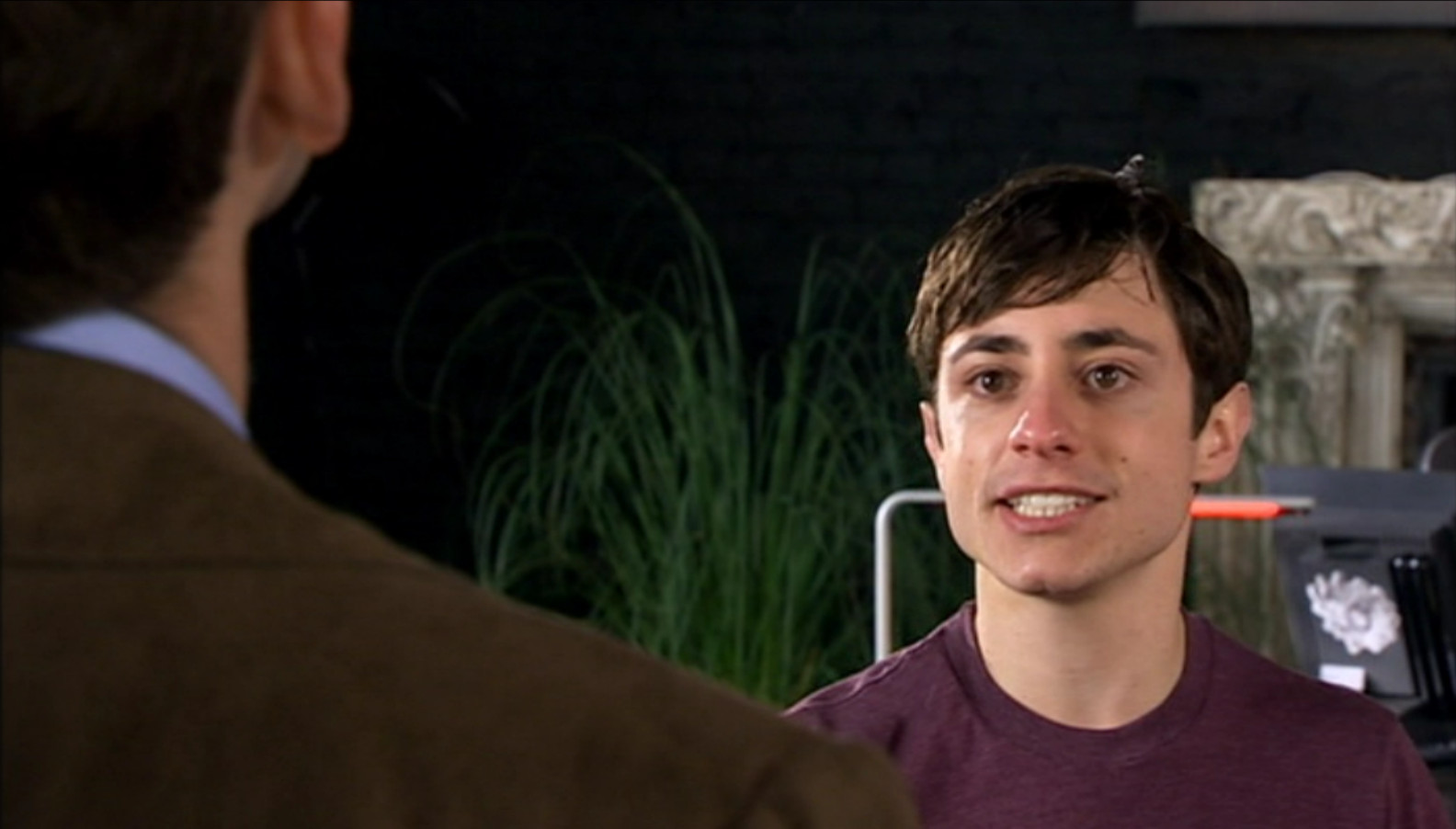
Young Luke Rattigan schools the Doctor in the meaning of “tautology.” (“The Sontaran Stratagem,” Doctor Who, created by Sydney Newman, C.E. Webber, and Donald Wilson, Series 4[revived era], Episode 4, BBC Wales, 2008)
One of the more grating moments of the rebooted Doctor Who series from the late aughts occurred in the episode “The Sontaran Stratagem.” The scene in question involved the young, American, obnoxiously arrogant tech genius Luke Rattigan (not the writers’ subtlest work there) having a fit of pique over a slight gaffe on the part of the Doctor, who has just said something about the ATMOS system that Rattigan created. Because the S in the acronym stands for “System,” saying “ATMOS system” as the Doctor did means that one is saying “system system,” effectively.
“It’s a tautology!” Rattigan whines. “A tautology!”
It is a petty, childish moment, and despite the genuine irritation it invokes, I cannot deny that it was a powerfully memorable bit of writing and acting, as it has lived in the collected brain-holes of my entire family for the better part of the past two decades. Occasionally, in fact, we’ve used the line as a bit of pantomime when one of us wishes to create humor out of a moment of tedious pedantry.
“You can’t say ‘added bonus,’ because a bonus means something additional. It’s a tautology! A tautology!”
(Exhibit A for making the case that the McColls were criminally overlooked as a potential sitcom family, producing a steady stream of riotous side-splitting humor)
I find this voice playing in my head these days when I come across the phrase “lifelong learners” in print or online. In education circles, “creating lifelong learners” is frequently cited as a primary goal.
But we know now that learning happens throughout the waking lives of all of us. The National Academies of Sciences, Engineering, and Medicine, in their 2018 report, How People Learn II, stated, “Individuals learn outside of school and throughout their lives….outside of formal schooling, what and how much people learn is directed by their own choices and circumstances.” (National Academies, p. 197).
Maybe we’re figuring out how to use a new app, or we’re using that app to pick up the basics of another language. Or maybe we’re memorizing the lyrics and musical arrangements of all the songs on the album our favorite artist just dropped. Or we’re finally teaching ourselves how to spatchcock a chicken or the proper form for deadlifting. Or we’re matching faces to names in our new workplace or recalling navigation to that excellent coffee shop we stumbled across in our new neighborhood.
We can’t help ourselves. We learn stuff because we need to and because we want to. But mostly we do it because our brains are wired for it. Imagine how awful it would be if our brains DIDN’T do this! You sit down to watch the first episode of a new TV show that you’re all excited about, and then the next week, you have no recollection of the names of any of the characters or their relationships to one another or the conflicts that arose between them or the challenges that they faced. It would be as though every episode was the pilot for you.
Friends, Episode 2, “The One With All Those Guys Whose Names I Can’t Remember” (actually, it’s “The One With the Sonogram at the End,” Friends, created by David Crane and Marta Kauffman, Season 1, Episode 2, Bright/Kauffman/Crane Productions in association with Warner Bros. Television Studios, 1994)
Which, of course, it isn’t, because of all the things you learned in the last episode.
So saying “we hope to produce lifelong learners” is kind of like saying, “we hope to produce organisms that metabolize sugars or shed skin cells regularly.” What, then, do we mean when we say someone will be learning as long as they have life? No doubt there will be important variation in answers to this question, but as a starting point, I feel the majority of educational thinkers would insist that a lifelong learner remain healthily and energetically CURIOUS.
Me personally, I think curiosity is just the genuine hope that the head you lift off your pillow in the morning will have more new interesting bits in it before it hits the pillow again that night. To me it means feeling the tug of a mystery or the involuntary head-tilt of wonder and then indulging the feelings that follow.
But that’s just me. Naturally, when it came to what experts on the subject might think, I was understandably…erm…
In the mid-20th century, psychologist Daniel Berlyne noticed something unusual about curiosity, relative to other virtues or intellectual traits: it shared qualities with basic urges, like hunger and sex. Berlyne noted that hunger and sex cause sensations which prompt the body to take action in order to alleviate those sensations. The process of alleviation is often experienced pleasurably by the organism in question.
These, Berlyne observed, are the same basic elements of the experience of curiosity: a person comes up against a new environment or a question leading into a new realm of information. An internal “itch” forms, pushing the person to explore the environment or to find the answer to the question. Upon satisfying this urge, the person experiences a sense of pleasure, of varying intensity. This is the happiness we see on children’s faces when they open birthday presents, and it may be one reason sales of advent calendars are slated to almost double in the next 7-8 years.
The picture than finally answers the question, “What if a birdhouse and a croquembouche gave birth to an advent calendar?” (Accessed on Etsy.com, 6 August 2026)
In fact, small amounts of dopamine are released even before curious urges are satisfied, during the “seeking” phase (for good or ill, this fact has been exploited by the makers of countless video games to keep players “engaged”). This likely contributes to children’s giddy enjoyment of such things as treasure hunts and hide-and-seek. It makes more complex puzzles more satisfying, as one must first address smaller unknowns in order to achieve the larger goal – like answering intersecting crossword clues to help work out the longest themed answers, or like taking on an adventure game’s smaller quests to receive information or items that help solve an overarching mystery.
Indeed, a good argument could be made for the most engaging element of curiosity being the element of surprise. When it comes to trying to cultivate a sense of curiosity in the classroom, this argument provides both one of the greatest educational opportunities and one of the greatest educational obstacles.
First the obstacle: formal curricula essentially function on the mathematical inverse of surprise. In most schools, each day’s lessons are fastidiously crafted, often after numerous iterations and adjustments. Learning objectives are known and frequently stated up front. The trajectory from the start of class (i.e. Arrival of Students Who Do Not Possess the Day’s Content and Objectives) to the end (i.e. Successful Installation of Content and Objectives in Students’ Minds) follows a relatively straight line, guided by leading questions, review of selected past material, and gentle exploration of new material. As a general rule, surprises tend to be treated as distractions that deplete precious minutes of class time and endanger the day’s mission.
But so often the best teachers behave like judo masters, finding ways to use the weight of obstacles as a force to defeat those same obstacles. Take for instance the review and statement of objectives that many teachers use to start their classes. I once knew a science teacher who had a set of boxes with resettable combination locks on them (something like this, or perhaps this, maybe this, or even this – unless you want to 3-D print your own). In each class, he’d put a series of review questions on the board; the answer to each question was the code to open one of the boxes. The first student to come up with an answer got to try opening a box – if it didn’t work, the student had to figure out their mistake and try again. If the combination worked, the student would open the box to discover some piece of that day’s lesson – a bit of lab equipment, perhaps, or a stated goal for the day on a piece of paper.
Here’s what the 3D-printed cryptex looks like, in case you were…curious (accessed atPrintables.comon 11 August 2026)
Et voila! The element of surprise, rather than distracting from review and goals, becomes a fuel that pushes students to test their recall of past material and to find their goals for the day’s work! While some may suggest that this technique naturally lends itself to a science lesson, questions can be asked on any number of subjects. Students can be asked to find instances of specific images, motifs, or character behaviors in novels, with page numbers being used to calculate combinations. Similarly, questions leading to lock combinations could be asked in other languages, with the mystery boxes concealing sets of vocabulary for the day’s work.
Beyond this, it is important to note that the combination locks and strongboxes or cryptexes are merely props – the same effect could be achieved by having students recite answers as passwords to the teacher as “Spymaster” or “Sphinx”; in this role, she or he would, upon being told the correct password, hand out folded pieces of paper with nuggets about the day’s work.
But in truth, even this level of complexity may not be necessary. In her book, The Hungry Mind, the psychologist, researcher, and Williams College lecturer Susan Engel refers to a 1991 article by James Stigler and Harold Stevenson, “How Asian Teachers Polish Each Lesson to Perfection.” Early in the article, Stigler and Stevenson relate the story of a Grade 5 teacher in Japan who enters her classroom with a plain brown paper bag that makes a clinking noise as she walks to her desk, raising the interest of all the students in the room. At her desk, she removes six different glass containers from the bag – a bottle, a vase, a pitcher, and so on. She wonders aloud which would hold the most water, and the children shout their guesses. The teacher points out that they don’t all agree, then wonders again how to find out who is right. From here, the teacher largely follows the lead of the children: they want to fill the containers with water, so she arranges for water to be brought to the room. They want something to transfer water from the holding bucket to the different containers, so she provides paper cups. By the time the activity is over, the children have worked out for themselves what a bar graph is and how to read it, and they have planted seeds in their minds related to data integrity – all stemming from a paper bag and some wondering. (Engel, 181; Stigler and Stevenson, 2)
Archival photos of math classes from the 1920s
In their book In Search of Deeper Learning, Jal Mehta and Sarah Fine tell analogous stories, notably one involving a high-school math class and a bag of balloons. Using a “see, think, wonder” protocol, students are encouraged to ask whatever questions they can (again, student questions are turned into the driver of the lesson, not the obstacle to be circumvented); some are answered, and some are not. Prompted by a student, the teacher blows up a balloon and wonders aloud, “How many breaths will it take to blow this up?” As students respond, the teacher then wonders if there might be a way to know how many breaths will fill any balloon. As the students begin suggesting methods, another teacher enters the room with a balloon large enough to hide behind – and the true challenge is set. (Mehta and Fine, 301)
All of these strategies can ensure that curiosity is exercised in classrooms, and schools might do well to provide professional development opportunities for faculty to brainstorm further possibilities and to receive training to employ them. That said, schools who wish to actually embed curiosity, who expect curiosity to endure through the lives of their students, will need to think more holistically – that is, to look at learning that goes on beyond the classroom.
When I was but a mere whippersnapper of a teacher, one of the first professional development workshops I attended included a viewing of the video, How Difficult Can This Be? by the acclaimed educator Rick Lavoie. About 56 minutes into the video, he discusses the work of the Harvard psychologist Lawrence Kohlberg, noted for developing a framework of the stages of moral development in children. Lavoie illustrates one of Kohlberg’s central tenets by describing a fictitious week during which he (Lavoie) decides to formally educate his son on the virtue of honesty. His “curriculum” involves hours of readings about historic figures noted for their honesty, religious texts that offer wisdom on the subject, role-playing, and more. At the end of the week, to celebrate his son’s success in completing the work, Lavoie takes him to the movies, where prices for children under 12 are lower. Lavoie tells his son, “I know you’re 12, but when we get up to the counter, tell the lady that you’re 10.” Lavoie and Kohlberg assert that this five-second exchange with the boy teaches him more about honesty than all of the work of the preceding week.
I’ve been thinking about this moment in this video for over 35 years, because it illustrates a truth about education that we often overlook – a point entirely connected to my earlier remarks about “lifelong learning.” When we use that phrase “lifelong learning,” we typically have our eyes focused on a distant horizon, watching to make sure that our aging students continue to learn up through their octogenarian years and beyond (an observation, I repeat, that is unnecessary because human brains are neurologically wired blah blah blah). The point being, by focusing so far ahead, we miss a lot that’s happening at our feet.
The concern around lifelong learning seems to stem from our idea that learning is much harder to do when it happens outside classrooms (no, it isn’t). We educators can wear blinders as far as this idea goes, as though schools do Learning With a Capital L which is somehow distinct from and better than all other varieties of learning. Of course, if we tried to present this point of view to any toddler, they would look at us as though we had a third ear in the center of our collective forehead. After all, from Age Zero to the day they start school, children experience learning as watching, listening, climbing onto things, banging things against different things, occasionally popping smaller things (or smallish pieces of bigger things) into their mouths to see what can be gleaned that way, and of course asking 497,000 questions once words become available to them.
A book series from the 80s tried to help parents with children’s questions. This one has 60 pages just about things a velociraptor can run faster than.
In school, climbing, banging, and masticating are typically frowned upon as learning techniques. Which would be fine, if questions were allowed. But copious research tells us that, across the years of school, children ask fewer and fewer questions, likely due to being discouraged from doing so in the classroom. In The Hungry Mind, Susan Engel reports that preschool toddlers can ask as many as 107 questions every hour, but by the time many children are in Grade 5, the majority of questions asked in a classroom are being asked by teachers, as a way to direct students through a particular lesson. In one particularly bleak anecdote, Engel tells of a Grade 10 history class she observed, in which a student raised his hand to ask a question about the American Revolution. Rather than entertaining his inquiry, the teacher simply said, “I can’t answer questions right now. Now it’s time for learning” (Engel, 100).
Schools can preach curiosity all they want – they can put up posters about famous curious people, present guest speakers who offer exciting stories about curiosity, talk about curiosity in all school communications. But the moment a teacher says, “I can’t answer questions right now. Now it’s time for learning,” the students become Lavoie’s son in the ticket line, being told to lie about his age by his father. They understand that adults SAY things about curiosity and they BEHAVE certain ways with regard to curiosity, and they perceive a fundamental disconnect between what is said and what is done. This disconnect colors everything else the school tells them about curiosity.
It is incumbent on all schools, then, to look within themselves – perhaps to do an audit to see how often student questions are allowed in class. In such an audit, categorizing the variety of questions would be important: if teachers allow questions on the topic at hand, but never engage any questions that might lead a discussion even slightly afield, this signals an important idea to students about the school’s tolerance level for curiosity.
More than this, though, schools need to look beyond the classroom: if a child is late coming in from recess because she was transfixed watching a caterpillar snack on a leaf, or if a child, asked to put away PE equipment, attempts (repeatedly) to get a ball to bounce on every step of a staircase when dropped, are these punishable offenses? Are the reasons for the children’s behavior discussed?
And then there’s the matter of role models – to what degree are admin, faculty, and staff in the school assessed on their demonstrated curiosity? Is this a part of professional evaluations?
My father was truly one of the most curious people I’ve ever known. He made sure we had not just one complete encyclopedia, but several (these were the pre-interweb times, mere moments after Charlemagne rose to power), along with numerous other reference books. At the dinner table, as we all discussed our days, when words or topics came up with which my father was unfamiliar, he would pop up from his chair, walk into the room next door, and pull out whatever volume might appropriately sate his need for answers. It was from him, I believe, that I developed my own instinctive insistence on answers – to this day, whenever a question poses itself in my mind, I feel compelled to track down information that satisfies it.
(This is actually annoyingly true – earlier in this essay, for instance, I used the word “spatchcock.” While I was able to let it lie for my first few read-throughs of the draft, on my third reading I just couldn’t take it anymore. I mean, it’s an utterly bizarre word. I had to know where it came from. For those playing at home, I can tell you the prevailing theory is that the word is an old-time portmanteau of the phrase “dispatch a cockerel.” You’re welcome.)
The reference for the earliest known definition of “spatchcock” –Grose’s Classical Dictionary of the Vulgar Tongue, compiled by Francis Grose, Esq., originally in 1785, though this is from the third edition of his dictionary in 1823
Who are the role models of curiosity in your community? Here’s one test you can use to flush them out: ask students, “Which of your teachers is most likely to be distracted from classwork when students ask certain questions?” This isn’t a perfect test, to be sure, but students have a keen sense for teachers whose mind is only vaguely tethered to the matter at hand and ready to float away with the students into more interesting explorations – generations of students over the years have waged quiet psychological warfare trying to be the hero who subtly, gently, but effectively sets their teacher loose.
And when a teacher abandons the day’s work for other pursuits – current events, a construction project across the street, a paper airplane contest, the controversial final episode of a much-loved TV series – how is this viewed by his superiors? To complicate it further, if one teacher on a team is more prone to digression than others, and falls further and further behind in the units of study, is the curious teacher sanctioned? Or are the others on the team urged to indulge moments of curiosity? To use the tech vernacular, do you treat curiosity among faculty as a “bug” or a “feature”?
If you require inspiration, I could point you to the book, “Surely You’re Joking, Mr Feynman!”: Adventures of a Curious Character[1], one of the collections of memories of Nobel Prize-winning physicist Richard Feynman. In the chapter, “The Amateur Scientist,” Feynman describes his period doing graduate work at Princeton and later working as a lecturer and researcher at Caltech, during which he developed a deep and ongoing fascination with the ants that lived around, and at times inside, his houses. Despite the activities having little or nothing to do with his actual studies, Feynman talks of long hours and elaborate experiments employed to understand ant behavior. Ultimately, what he learned enabled him to humanely remove an ant infestation from his pantry in California. One of the greatest minds of the past 100 years literally spent his time making bugs a feature. (Feynman, 93-97)
Feynman was not fired or chastised for his entomological pursuits; he was not told that his obsession with ants was creating problems in his lectures. Of course, it would be easy to look back and say, “Oh, well, but he did that because he’s a genius! That’s the way of geniuses – it’s part of their process.” And there may be some truth in this. But I feel that Feynman himself would say that this is not his process; it’s just the process. It’s the way our brains work.
Decades of research have shown that children’s curiosity is used by their brains to build ever more elaborate understandings of the world around them. As they encounter new elements of that world, children ask questions and assess and explore until they’re able to fit the new element into their expanded worldview. The larger we allow children’s worldview to become, the greater the resource they have to draw on when addressing challenges. Curiosity feeds development of confidence, risk-taking, and creative problem-solving.
Which means, if we are successful in supporting curiosity in the classroom AND we are able to avoid punishing curiosity outside the classroom AND we set up adults in the community who effectively model curiosity for children…then we…will probably need some way of knowing how well students develop curiosity, right?
I say this because in the examples I gave above, all the students were assessed on was the content delivered in the class, not on the level of curiosity they demonstrated. That science teacher I mentioned? He didn’t track who the first student was each day to start cracking the box codes, nor did he take notes on how the students investigated new pieces of lab equipment they may have uncovered. But he did caution students who were unsuccessful at opening a box, telling them they needed to review their old material more.
The students in that Japanese class? The teacher made sure they knew what a bar graph was, but no credit was awarded to students who fell silent and focused on the paper bag the second they noticed it, nor to those who asked the best questions once the glass bottles were revealed.
The curiosity was used as the key to the treasure, but it was not the treasure itself. Which makes no sense from a biological standpoint – earlier I referred to neurological studies that confirm that satisfying a curious urge causes a dopamine release in our brains. Dopamine is a vital chemical in human behavior construction: due to the curiosity/dopamine connection, humans find learning pleasurable; when humans find behaviors pleasurable, they have a greater tendency to continue those behaviors. Therefore, reinforcing the curiosity/dopamine response will likely strengthen the desire to learn.
Notice, if you will, that nowhere in the research does the content of the learning matter with regard to the dopamine response. In other words, taking an interest in the way the concept of quantum superposition enters into the Schrodinger’s Cat thought experiment will produce precisely the same neurological response as seeking out the answer to the question, “Hang on, was that a young Sam Rockwell I just saw in that second-season repeat of Law & Order?”
Spoiler alert: yes, it was (“Intolerance,”Law & Order, created by Dick Wolf, Season 2,Episode 20, Wolf Entertainment in association with Universal Television, 1992)
So using curiosity as a key and treating the content as the treasure misses the point: the content is not the thing that will produce lifelong learning – the key is. To put it as American author John Barth did in his 2001 novella, Dunyazadiad, “The key to the treasure IS the treasure.” (Barth, 11)
Now, we have all sorts of tests and standards and measures for our content, but very few instruments for measuring curiosity.
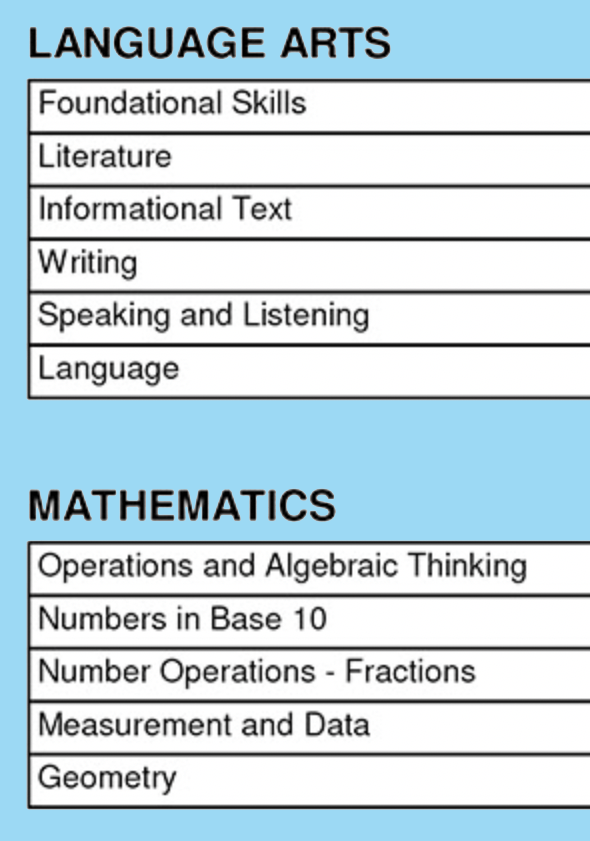
To start, there is the question of what, precisely, to assess when looking at children’s curiosity. When schools describe development in math and language, they utilize report cards that identify various learning components, such as those in this sample. Each smaller category addresses a different way a student’s skills in the larger category might manifest.
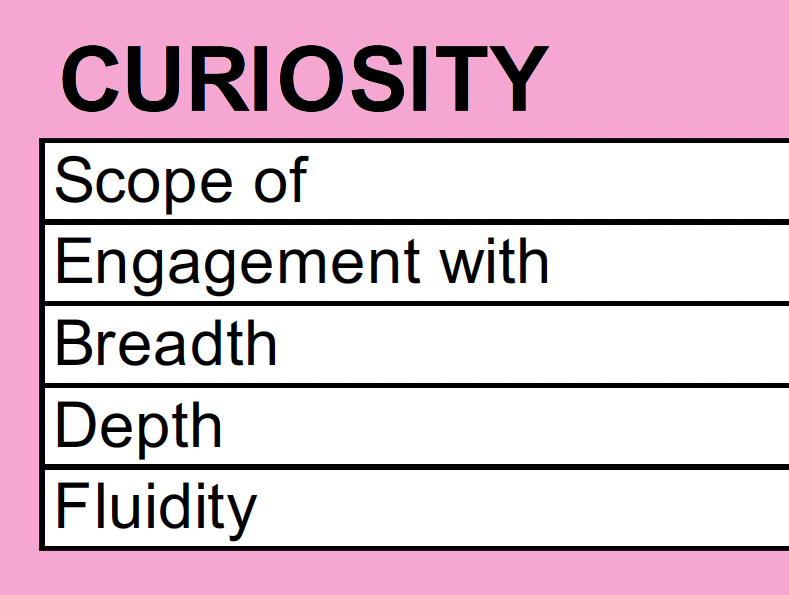
How might we understand curiosity in terms of its composite elements? For instance, does a child limit her curiosity to things that directly affect her in the moment? Or does she show equal investment in ideas entirely outside her realm of experience? What is the scope of her curiosity?
There is also the concept of engagement – when he receives his graded English essay back from his teacher, does a student simply look at the grade on top, and toss the paper away? Or does he look at the grade and immediately pore over the margins reading every one of the teacher’s comments? How quickly does he react to new things? How excited does he become?
Then we could consider students’ ability to generate questions (that is, once we build space for curious questions during our classes) – do students come up with questions quickly and easily? Can they access the vocabulary they need to express their questions clearly? Do their questions suggest avenues for discussion and/or exploration? Such considerations speak to the fluid nature of students’ curiosity.
With all this as a foundation, we might provide enough subheadings for our own reporting on students’ development of curiosity, using a reporting structure like this one:
Next, for each subheading related to ELA and math, there will exist sets of corresponding standards, achievement of which can be expressed as a point along a continuum (a grade, a number, perhaps a ranking like “Approaching/Meets/Exceeds”) with descriptors:
Analogous continua, then, would need to be constructed for curiosity’s subheadings. Take engagement. How might this manifest, in concrete terms? A child who does not engage with his curiosity might receive new information, but not do anything with it. He would not formulate follow-up questions on a topic, for example, or manipulate a new object to try to intuit its structure or operation.
A child whose engagement with curiosity is somewhat more developed, on the other hand, upon being presented with a new concept or object, will verbalize connections that reflect their interest – “I saw a bear like that at the zoo, only it was a lot bigger, and it wasn’t red,” or “My cousin has a white board that blows air like that, except it’s a game and it has legs.” These connections will naturally lead this child to questions, like “Is that bear in a zoo?” or “Can we play a game on that board too?”
Over time an engagement continuum takes shape:
While this continuum is incomplete (we haven’t stated how those students with heightened engagement might express it), it is worth noting that the continuum as written here could be used in any grade for any subject, not unlike many descriptors in conventional school subjects. Grade-specific variation there tends to be found in curricular standards and objectives.
One of the subcategories for mathematics achievement above was “Geometry.” This means that a school (or school district or local or national curriculum) will likely have written goals for students with regard to their geometry skills and knowledge, differentiated by grade. In Grade 6, for example, the Common Core sets this as one objective for students in geometry:
CCSS MATH CONTENT 6GA
Students will solve real-world and mathematical problems involving area, surface area, and volume.
Set under this objective are standards to demonstrate acquisition of the objective:
“CCSS MATH CONTENT 6GA1: Students willfind the area of right triangles, other triangles, special quadrilaterals, and polygons by composing into rectangles or decomposing into triangles and other shapes; students will apply these techniques in the context of solving real-world and mathematical problems.”
Curiosity, then, should have comparable standards and objectives:
CCVE CURIOSITY CONTENT 6BD
Students will apply existing knowledge to speculate about newly encountered, real-world situations, across disciplines and outside the classroom.
“CCVE CURIOSITY CONTENT 6BD1: Students will use knowledge of area, volume, and geometry tointerpret and make sense of new information and situations presented to them; students will actively employ these skills to determine the practicability and logic of new information.”
I envision a standard like this being assessed in any number of places:
students given a chunk of honeycomb and a frame that is X by Y centimeters, who on their own set about determining how many cells the frame could have
a debate during advisory over a local news article about a student arrested for a senior prank involving framing the football field with stolen flagpoles and the plausibility of said plan
a girl doodling in her notebook with notes from The Maze Runner, using details of the kids’ activities to create a scaled map of the maze
These curriculum components for curiosity are only samples of what’s possible, of course, but even these provide a tantalizing taste of what a school might be like when it truly prioritizes curiosity. I find myself imagining answers to questions like…
How would lesson plans be different when designed to assess standards of curiosity?
How would classroom dynamics change when curiosity is a daily objective? How would dynamics change in other areas of school?
What would happen long-term to the student experience – to the interactions of students with one another and with teachers – as students grow in their curiosity?
I imagine a time in the not-too-distant future, at a brand-new school, where students are given more freedom, encouraged to follow their own pursuits alongside those of the school, but to do so as part of the formal curriculum, giving equal weight to what the students want to know and study. Setting up a lab to study ants, say, while they learn their physics.
Which, oddly enough, brings me back to that Doctor Who episode where I began. Because, as it happens, my description of that imaginary school strangely resembles Rattigan Academy, the institution founded by Luke Rattigan, with some of the billions he made from his tech empire. Turns out he has devised a plan that will render the Earth uninhabitable. But he’s not terribly concerned, as he has also worked out a way to survive while everyone else dies. And, worst-case scenario, he figures he can always just head off into space.
Can you imagine? I tell you – the ideas those scifi writers have…
Of course, Rattigan doesn’t succeed, partly because all his students turn on him when they find out he wants to kill their families and friends. If he’d been a little more interested in them as people, he might have twigged this sooner.
Mostly, though Rattigan loses because the Doctor grows curious about his goings-on. This is, for me, possibly the great secret to the long success of Doctor Who: it is a TV series built almost entirely around one man’s curiosity. The character of the Doctor actually started out as a bored inhabitant of the planet Gallifrey who wanted to “see the Universe,” so he stole a TARDIS (a machine to help him travel through time and space) and spent hundreds of years wandering around finding out about stuff.
Soooooo many episodes involve the Doctor wondering what made that ship crash, or why all the people on the station are cryogenically frozen, or what secrets the library can tell us about that alien creature. But even in small moments, when he’s not saving a planet, the Doctor’s primary motivation seems to be curiosity.
In one of my favorite old episodes, “The Ribos Operation,” the Doctor and his companion Romana have been taken prisoner by a bloodthirsty warlord, who believes they are in league with a con artist who tried to steal billions from him. The Doctor can’t resist the opportunity to ask the con artist questions about his past and what led him up to his latest caper. Romana, frustrated by his nonchalance, yells at him, “There are men out there planning to kill us, and you’re just sitting here?!” The Doctor reassures her warmly and invites her to sit with him, saying, “Oh, Romana, when you’ve faced death as many times as I have, this is much more fun.”
The Doctor & Romana find themselves in yet another curious situation (“The Ribos Operation, Part 3,” Doctor Who, created by Newman, Webber and Wilson, Season 16, Episode 3, BBC Television, 1978)
The Doctor’s curiosity is all the things we want children’s curiosity to grow up to be: broad and deep and fluid and obscure and constantly engaged. Many, many of the Doctor’s greatest foes are machines (or partly machines, anyway): the Daleks, the Cybermen, and the Great Intelligence, to name only the most obvious few. They are all fixated on their single purpose, which renders them uninterested in anything else. Invariably, it is this very predictability which has allowed the doctor to be so successful against all of them so very many times.
The Doctor points out that the Movellans, an army of androids obsessed with defeating the Daleks, never learned games like Rock, Paper, Scissors (“Destiny of the Daleks, Part 4,”Doctor Who, created by Newman, Webber and Wilson, Season 17, Episode 4, BBC Television, 1979)
What a fantastic role model for young people – all people really – in an age when technology is so often presented as an existential threat. The Doctor embodies the idea that technology can never defeat us or replace us, as long as we can exercise our curiosities. The Doctor is fascinated by stars and technology and history and music and art and biology. He is fascinated by the mysteries he encounters and wonders about ways to escape the perils facing him and the Earth and others. And in the midst of all that, he still finds time to be fascinated by people.
Which is something AI can never do. If you tell AI to write an article for you about curiosity, it won’t take time out to give you a psychological profile of the eponymous hero of a scifi TV show or to detail the nerdy preoccupations of a Nobel Prize-winning physicist. And it certainly won’t show you a picture of the man who first committed the etymology of the word “spatchcock” to print. Because, as far as AI is concerned, these people are not important, so there is no need to mention them.
Just like there is no need to mention the fact that the etymology of “Doctor” is the Latin word docēre, meaning “to teach.” So the Doctor, it turns out, is not merely a role model for our students, but a role model for our teachers too.
Like the Doctor, we need to arrive in our schools ready to show our students that we can’t let things that frighten us keep us from connecting with people, getting to know them. Indeed, just as the Doctor delights in all the new people he meets and all the new places he visits, we need to model for our students the joy that comes from curiosity and discovery. Because that’s what curiosity’s kick of dopamine, that little neurochemical flicker, is: for lack of a better, more scientific word – it’s joy. Our curiosity about the world and each other is quite literally a joyous experience.
What a fantastic thing to teach our young people: not only is curiosity the superpower they can use to save the world, but as they do, they will feel incredible. You might say that the joy of curiosity is a kind of added bonus. But of course…
Works Cited
Barth, John. Chimera. New York: Random House, 1972.
Berlyne, Daniel E. Conflict, Arousal, and Curiosity. New York: McGraw Hill Book Company, 1960.
Engel, Susan. The Hungry Mind: The Origins of Curiosity in Childhood. Cambridge: Harvard University Press, 2015.
Feynman, Richard. “Surely You’re Joking, Mr Feynman!” – Adventures of a Curious Character. New York: Vintage, 1985.
Lavoie, Richard. How Difficult Can This Be? Understanding Learning Disabilities. PBS Video, 1989.
Mehta, Jal and Sarah Fine. In Search of Deeper Learning: The Quest to Remake the American High School. Cambridge: Harvard University Press, 2019.
National Academies of Sciences, Engineering, and Medicine. How People Learn II: Learners, Contexts, and Cultures. Washington, DC: The National Academies Press, 2018.
Stigler, James & Harold Stevenson. “How Asian Teachers Polish Each Lesson to Perfection.” American Educator, No. 15, January 1991.
[1] I was very sad to learn that the sequel to this book was NOT entitled, “No, I’m Not Joking, and Stop Calling Me Shirley!”: Further Adventures of a Curious Character
A couple years ago, my wife and I had the chance to fulfill a decades-long dream of visiting Australia. There are a hundred stories worth telling from this trip, but for now I will limit myself to a single happy encounter during our stay in Melbourne.
Let me preface this by confessing that I can be a tedious person with whom to travel. When I arrive in any city, my first priority is locating any and all bookstores (or even stores of other varieties that may contain small sections of books) and spending as much time in them as possible, attempting to commit their selections to memory for future reference. You can tell a lot about a city from its bookstores, and you can tell a lot about a bookstore based on what it chooses to stock.1 It behooves one, then, upon arriving in a new place, to map and gene-sequence the book suppliers in order to fully understand the Municipal Organism.2
Melbourne presented itself as a very fine book city, and one strand of protein we stumbled upon was the Hill of Content bookshop on Bourke Street, a cozy place with a richly rewarding variety of books available. Having opened over a century ago, it is Melbourne’s oldest book emporium.
With this, I tote the philosophical weight of a mighty question.
So much did I enjoy my time in their establishment that I chose to purchase one of their branded totes as a memento. The totes draw attention to the persistent mystery of Hill of Content: where should one put the emphasis? Is it the “Hill of CONtent” bookshop, conjuring up an image of an enormous mound of books? Or is it the “Hill of ConTENT” bookshop, evoking the sensation of quiet pleasure, joy, and satisfaction one often derives from a well-selected volume and a relaxing session of page-turning? No one can say for sure, and the debate rages on.
The more time I’ve spent with this bag and its provocative question, the more I’ve come to believe the same question plagues the world of education. Overwhelmingly, schools seem to be measured by their ability to deliver content, rather than contentment, to students.
In fairness, I know of a great many schools with powerful academic reputations that have worked diligently in the past ten years or more to address concerns around student stress and to promote well-being. Schools want their learning environments to be enjoyable spaces for young people. Many that I know provide “mental health days” with breaks from class, counseling sessions, even therapy dogs. Some have created “intersession” days during the school year, where students and teachers stop working with the normal curriculum and instead spend time on non-graded, new activities like pilates, crossword design, tae kwon do, knitting, model rocketry, or baking. Schools have tried to increase the individual time students have to talk about how they’re feeling; to this end many train older “peer counselors” who help by talking about how they coped when they were the age of younger students.
But…
Most schools still employ a specific mandatory curriculum, one that generally offers little by way of choice, particularly among younger ages. Most schools still utilize exams or tests of one sort or another as their primary mechanism for assessing student achievement of curricular standards. Most schools create tiered classes in at least one subject, which can have the effect of lumping the highest-performing students (from a conventional GPA standpoint) together in other – even all – subjects. Most schools encourage competition either through class rankings (to determine, ultimately, valedictorian and salutatorian awards) or through academic prizes of various sorts. Most schools want to be able to tell families that 100% of their graduates end up at a four-year college, and that a significant percentage of those graduates attend “extremely selective”3 universities.
It seems clear that removing any one of the above items as a school priority would go a considerable way to alleviating the stress felt by students. But I know when I write those words that most people find this idea laughable – even grossly negligent. Ambitious parents hope that schools, ultimately, will enable their children to compete and win places at selective universities; most believe this means enabling their children to achieve high grades and to win prizes that look good on college applications. Schools point out that universities and the work force are competitive situations, requiring students to demonstrate what they know and to try to edge ahead of others for limited opportunities. For a school NOT to prepare students to enter the real world would be criminal.
No doubt you, like me, see the situation as reminiscent of that iconic moment in Star Trek II: The Wrath of Khan.
We learn in Nicholas Meyer’s 1982 sci-fi masterpiece that Starfleet cadets seeking command positions are required to take part in the “Kobayashi Maru exercise.” This is a kind of role-playing game in which the applicant assumes command of a starfleet ship that receives a distress call from another (the Kobayashi Maru of the title) in enemy territory. Approaching to provide assistance, the applicant finds him/herself attacked by three enemy vessels and quickly outmaneuvered and outgunned.
The Kobayashi Maru scenario frequently wreaks havoc with students and equipment, Mr Spock informs us. (Star Trek II: The Wrath of Khan. Directed by Nicholas Meyer, Paramount Pictures, 1982)
The game is designed to be unwinnable, intending not so much to test battle strategy as to evaluate how the would-be captain faces up to certain death.
Only one cadet in the history of Starfleet has ever “won” – come out of the Kobayashi Maru exercise with his ship, crew, and person intact: James T. Kirk. We learn later in the movie that he won by sneaking into the simulator the night before his test and reprogramming the scenario so that there was a path to victory.
Effectively, then, as Kirk’s son points out, he cheated.
College game theory classes love putting students through these types of expansive thought experiments. The Prisoner’s Dilemma is a typical example. In it, two prisoners accused of the same crime are interrogated separately. If Prisoner A “confirms” (rats on Prisoner B) while Prisoner B “denies” (says nothing), Prisoner A goes free and Prisoner B serves 5 years in prison. If both confirm, they each serve 3 years in prison. If both deny, they each serve 1 year in prison. So if you’re Prisoner A, what should you say to the police, if anything?
Outcomes grid for the Prisoner’s Dilemma – here Player A denies (D) while Player B confirms (C). The diamond on the left shows the result – 5 years for A, 0 for B. (Credit:Veritasium Youtube Channel, 23 Dec 2023, accessed 17 Mar 2026)
When I first read about this game, I remember having the feeling Kirk must have had when faced with the Kobayashi Maru: what a lousy couple of choices. Let 300 people die on the stranded ship, or lead my own ship to certain doom? Speak up and likely face 3 years in prison, or say nothing and risk a 5-year sentence?
The Prisoner’s Dilemma asks us to turn philosophical considerations about our control over our personal freedom into some kind of minimum-information problem. In the situation, am I not guilty? What was the crime? Do I know for sure that the other prisoner did it? Is there evidence to defend the charge? If I’m in prison for 5 years, is there any chance of early release? Do I have a lawyer? What is s/he recommending?
I realize that asking these questions obscures the purpose of the game a bit (i.e. calculating best options in a linked-outcome situation when you have no information about the other linked choice), but the alternative is allowing a conversation around criminal justice and sentencing guidelines to be reduced to a statistical function, which I find problematic.
Like Kirk, I wanted to reprogram the game.
Returning to the question of schools and student mental health, I feel the whispers of the Kobayashi Maru in my ears again: what a lousy couple of choices – either enable systems that produce inordinate stress in young people, or send them into their futures largely hobbled in their ability to lead “successful” lives.
Why are these the only choices?
In virtually all the books and essays I’ve come across regarding the Prisoner’s Dilemma, it is treated as a problem of rational thought vs irrational thought: the way to avoid the longest sentence (5 years) is for each prisoner to confirm, though doing so will mean they each serve 3 years. On the other hand, if each does the irrational thing, they will both serve only 1 year. Most analyses discuss navigating the tension between rational and irrational decision-making.
No discussion of guilt, or the law, or evidence, or justice, or responsibility, or freedom, or conscience, or loyalty,4 or due process – all of which would form a part of pretty much any person’s decision-making were they to find themselves in this actual situation. The game asks us to remove important questions of human values from the equation – and then to take what we’ve learned and apply it to real-world situations. Which implies that we should also, what, disregard human values from the real-world situations as well?
Similarly, in the Kobayashi Maru scenario, cadets are asked to look past the hundreds of lives that would potentially be lost (including their own)5 and to somehow engage with the “leadership lesson” being taught as they make a series of futile commands in the fleeting final minutes of their simulated existence.
Kirk understood even one lost life can be an onerous burden, let alone hundreds. The fact is, if a no-win situation like Kobayashi Maru comes our way, no amount of preparation will change the ending. So, Kirk rightly considers, how is it a good use of time to practice this ending, when we could instead put that same energy toward finding ways to AVOID these no-win situations?
Kirk faces the loss first of a young ensign and then of his best friend (Star Trek II: The Wrath of Khan. Directed by Nicholas Meyer, Paramount Pictures, 1982)
(Incidentally, “Kobayashi” is one of the most common surnames in Japan, roughly as common as Davis in the US. “Maru” is a common ending word for ships, used to denote perfection and safety. But read literally, the phrase “kobayashi maru” can mean “small, round forest.” Throughout Star Trek II there are a number of small, round settings–including an underground forest of sorts on a distant moon–frequently used as spaces where characters face what appears to be certain death. On several occasions, Kirk finds his way out of these “small, round woods” with unconventional thinking.)
What if the lesson of the Prisoner’s Dilemma involved teaching game theory students how to identify analagous situations in other areas of life and work, and then how to ensure that the decisions made – by both the prisoners and interrogators – are based in strong morals and ethical behavior? What if the Prisoner’s Dilemma encouraged students, in matters of justice and freedom, NOT to be reductionist in our thinking, limiting our decisions to a single data point like, “What’s the other guy gonna do?” What if instead, it taught that decisions around weighty matters deserve lengthy, complex deliberations? Deliberations that reference connecting concepts (e.g. freedom) and fundamental human values (e.g. justice)?
Again, I can practically hear the eye-rolling of those who feel that I’m being purposefully obtuse – I continue, some will say, to miss the whole point of the Prisoner’s Dilemma exercise. I would prefer to say that I haven’t missed the point, I have simply tried to substitute it for a point that is far less dangerous.
Yes, that’s right: dangerous.
I recently read an interview with the environmental writer and analyst Ketan Joshi. Mid-way through, the interviewer (Vlad Bunea) pointed out a number of things:
“There are a lot of reports (1, 2, 3,4) that tell us how bad the climate crisis is. If we were to use a metaphor it appears they are describing the water while we are drowning in it. They do not take a stance against the extra-scientific causes for these terrifying realities even though this would be perfectly well aligned with the scientific method.”
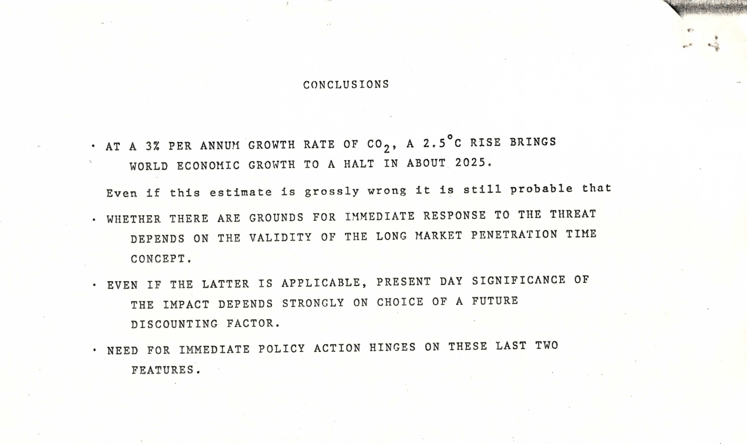
Among the causes the reports could have identified are the corporations who knew that ongoing, mass use of fossil fuels on a global scale would produce precisely the environmental effects we’re seeing now.6
Edward Teller, the “father of the hydrogen bomb,” clearly had very specific ideas about what constituted dangerous technologies (Oppenheimer. Directed by Christopher Nolan, Universal Pictures 2023)
As early as 1959, renowned physicist Edward Teller addressed a conference of petroleum executives7 and told of the dangers of the “greenhouse effect” from burning their products. In 1965, at a meeting of the American Petroleum Institute, their president, citing a study by US government advisors, warned of “catastrophic consequences” due to the increase in CO2 levels, causing “marked changes in climate” by the year 2000. That same organization created a “CO2 and Climate Task Force” in the 1970s, with members from major oil companies, that foresaw ongoing fossil fuel use causing “globally catastrophic effects” in the 21st century; then the API hid their findings from world governments, advising them instead to dramatically increase their coal consumption. Exxon leadership received (and widely shared) a memo from one of its own managers linking their business ambitions to a catastrophic future for large portions of the planet.
The fact that all this happened (we have detailed evidence of the deceptions), but scientists don’t feel they should talk about these things as root causes of our current situation feels very Kobayashi Maru/Prisoner’s Dilemma to me.
More fundamentally, as an educator, I feel as though those of us adults charged with guiding young people (who suffer increasingly from anxiety and mental health concerns related to the environment)8 into the future are Starfleet offering up the no-win situation, asking them to accept that people are going to die no matter what choices they make. We are game theorists telling students to be rational and accept one of a few bleak futures. We know that there are others making decisions entirely connected to the bleakness of students’ futures, but we don’t really talk about that. We don’t discuss the future with them from the standpoint of responsibility, or truth, or evidence, or justice, or even the law.9
Instead, we teach them to be resilient, we offer them mindfulness exercises, we encourage them to cultivate “the perspective that comes from realizing the potential of recovery and rebuilding.” Which feels to me a bit like telling Starfleet cadets, “The Kobayashi Maru is a situation you will probably encounter at some indistinct point in your future; you’ll see it coming and be powerless to stop it,” and then providing them with grief counseling.
It can make young people believe that we adults aren’t really interested in changing the way things are or improving the way the world works for them. And, when we then train them up to go through a college application process fairly indistinguishable from the one their grandparents experienced10 (swapping out computers for the paper-and-pen process of yesteryear), the sense that adults want to keep everything just like it is feels profoundly reinforced. Such experiences can affect students’ trust in educational institutions, to say nothing of their joy, motivation…even hope.
But…
What if we cheated?
A few months ago, Cory Doctorow wrote a piece in which he pitted William Gibson’s quote, “The street finds its own uses for things,” against Margaret Thatcher’s line about liberal capitalism, “There is no alternative.”
I can’t really offer a better illustration of Doctorow’s essay than his own. Enjoy.
Thatcher’s point was that, if you want to have the nice things that we have in our world, then we have to accept the bad stuff that goes along with it. Do you like having cars? Well, then, we’ll need to bleach the world’s coral reefs. A fan of air travel? That means you don’t care if the ice caps melt.
Doctorow argues that this is, like the Prisoner’s Dilemma, a reductionist point of view and suggests that Gibson’s observation offers a strong counter to Thatcherist thinking. Gibson points out that, no matter what you intend when you make a doohickey – a new technology, a movie, a tool, anything – no matter what you tell people it’s for, once they get hold of it, they will do with it what they please.
Your novels will spawn thousands of pages of fan fiction, taking characters places of which you never dreamed. Your nail polish remover will become an antidote for SuperGlue mishaps. Your duct tape will produce a functioning wallet while your yellow packing tape will fashion articles of clothing. Your explosive will make a useful heart medication. Your under-oven food-warming drawer will be repurposed for storage.
Effectively, like Nathaniel Hawthorne’s Owen Warland in “Artist of the Beautiful,” once we release our exquisitely-engineered mechanical butterfly into the child-like hands of the world, we are powerless to stop the world from grabbing it and breaking it into its component parts. And then using those parts to make a lockpick or a trap for spiders or a mechanical page-turner for sheet music.
So what if, in our schools, we offered our students the World with the expectation that they should do something radically different – and radically better– with it?
What if we treated our young people like wily Kirks and not doomed cadets? What if our education showed them the alternatives Thatcher denied and celebrated them as members of Gibson’s “street”? Our interrogators would offer the Prisoner copies of all the evidence and connect them with a great criminal defense attorney. Our Starfleet would hand Kirk the wiring diagram for the simulator and a bag of tools. And then explain what each tool is and how it can help revise the no-win situation.
The tools we must supply are many, myriad, and complex: our students must gear up with a sense of justice, responsibility, conscience, loyalty, compassion – all values that will enable them to identify problems that need correcting or avoiding. We must show them how to employ imagination, collaboration, open-mindedness, and resilience, so they can work together to find solutions to big problems. They’ll need to put in hours of training on reason, healthy skepticism, forgiveness, trust, and self-awareness to test themselves and their ideas and to own their mistakes.
This is a partial list of building blocks of a new curriculum. And what texts should we select?
We could introduce students to Michael Reynold’s Earthship design concept for sustainable homes, which has evolved and improved and spread since he conceived it in the 1970s. We could immerse them in hopepunk, afrofuturism, and other artistic movements imagining positive outcomes stemming from troubled pasts. We could encourage them to listen to the Upstream podcast as a way to come to grips with alternative economic models that might be better suited to a sustainable, equitable future. We could point them toward their local officials who could enact worthy changes close to home.
We could do all this and more. And maybe our students wouldn’t notice or wouldn’t care. Maybe they would just leave the world on its current trajectory.
Certainly, if we cling to the familiar well-worn paths that schools have always followed, the odds of our students doing the same increase.
But if we show them other paths, and if we give them useful tools and knowledge, and if we cheer them on as they leave the spaces we find comfortable, they might explore different paths through the small, round woods into the future – not without pitfalls and dangers, but with the benefit of being NEW and rich with POSSIBILITY.
This said, I should amend my thesis for this little diatribe. Not that I don’t want the children of today to find a measure of inner peace – I absolutely do. But, as Rutger Bregman says in his preface to Moral Ambition, complacency is a poor fertilizer for the seeds of change. In our warming world, we must help rising generations find and inhabit their winter of discontent, using the tools of character to dismantle the world we’ve offered them and to build an entirely new, better one for themselves.
In this blog and the accompanying podcast, The Children Who Will Change the World, I explore edits to our educational approach – some tiny, some rather larger – to make small tweaks that might lead to big tweaks that might lead to cultural shifts and to young adults emerging from our schools with a human toolbox at their disposal that’s as impressive as their academic one. Put another way, let’s do more content development aimed at developing some virtuous contention in our young people.
1 I’ve got a whole theory about this – but that’s fodder for a future piece.
2 Time should also be spent investigating and cataloging restaurants for identical reasons.
3 Defined as colleges and universities who accept less than 15% of their applicants.
4 What even IS the relationship between the Prisoners supposed to be? Why were they picked up together for this crime? So very many questions…
5 Cadets in the simulation are assured that the enemy ships will wipe out everyone, effectively making this, then, the “No Prisoners Dilemma.”
9 Indeed – when schools dare try to encourage students’ civic engagement on such matters, many accuse them of “making school political,” “promoting a left-leaning bias,” “brainwashing young people,” and worse. Schools can face hostile parents and even lawsuits which ultimately require the academic “both-sidesing” of an issue that almost the entire scientific community – as well as many oil company executives and almost all insurance companies – accepts as real.