
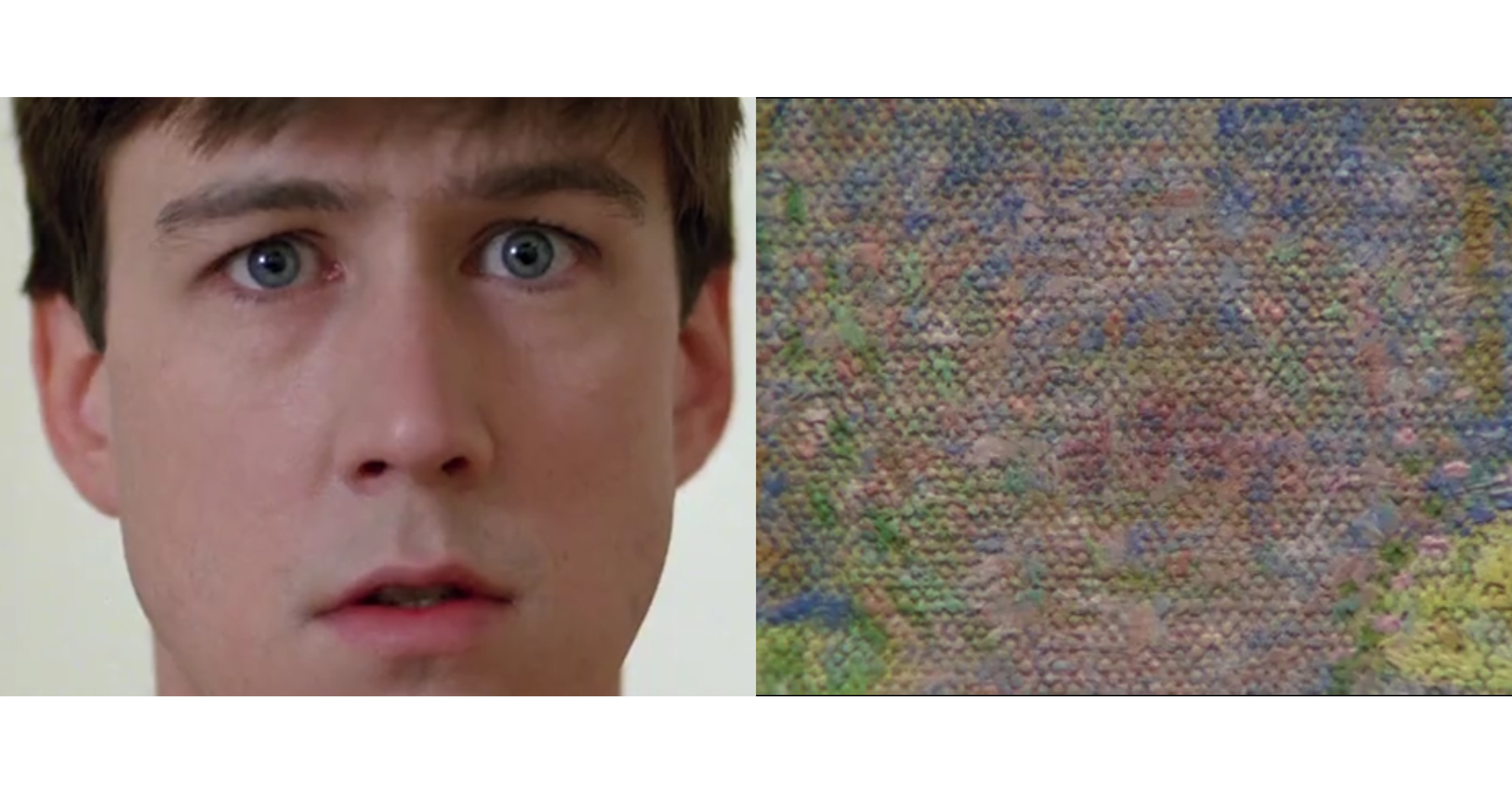
Cameron stares into the Seurat; the Seurat stares back into Cameron (Ferris Bueller’s Day Off. Directed by John Hughes, Paramount Pictures, 1986)
In John Hughes’ 1986 classic Ferris Bueller’s Day Off, Ferris, Sloane, and Cameron visit the Art Institute of Chicago. Cameron, struggling in many areas of his life, finds himself standing in front of the Georges Seurat painting, A Sunday on La Grande Jatte – 1884. He fixates on a little girl in the center of the painting, finding something of himself in her, perhaps something he misses from his younger life, and he focuses hard on her, as though trying to extract it and regain it for himself.
Of course, this is a pontillist work, and so the further into the picture Cameron gazes, the more the image dissolves into its constituent dots. The more Cameron “loses” the little girl, the more panicked he appears and the more his eyes grope at the picture, desperate to save the little girl from oblivion. After all, if he can’t rescue the little girl, how can he hope to save himself?
This moment spoke deeply to me when I saw it as a teenager. Those of us who are honest with ourselves, I think, identified much more strongly with awkward, unsure Cameron than with effortlessly charismatic, miraculously lucky Ferris. I imagined the near-magnetic pull of Seurat’s work (only intensified when I saw Sondheim’s love letter of a musical), and I often wondered if, standing where Cameron stood, I too would feel myself separating into tiny colored particles, as a distant oboe hauntingly offered strains of “Please Please Please Let Me Get What I Want.”
A few years ago, I finally had the opportunity to step figuratively into Cameron’s red Gordie Howe jersey. Often such moments, for me anyway, can suffer from a kind of patina of nostalgia that grows over the original memory. When reality scrapes away that coating, what remains sometimes disappoints.
Not so Seurat’s masterpiece.

From my 2025 visit to Cameron’s little friend (marked with the pink arrow)
The painting is in a different setting nowadays than it was in the movie, but that didn’t matter. Its pull is as wildly absorbing as I’d imagined – positively gravitational, fixing you in place before it. Questions materialize as you stare: how did I get here? why am I in the shade of the tree, when so many others sit in the sun? what is everyone looking at on the water? why are the woman with the orange parasol and her daughter not looking at the water, but staring at me? And yes, you find yourself pulled close by the gravity, realizing as your gaze drifts inward that your feet will never touch the grass on La Grande Jatte, because the grass, the hats, the animals, all is a lie: there is no green grass, merely thousands of blue and yellow dots and Seurat’s dark magic, his peculiar alchemy. If you allow it, you could let the truth of Seurat’s work dismantle you, just like Cameron.
Seurat invented the technique of chromoluminarism, a painstaking approach to color that involved precisely selected groupings of colors which, when viewed by the eye from a distance, presented as an entirely different color. As Sondheim’s George sings while painting a black hat, “More red…/And a little more red…/Blue blue blue blue/Blue blue blue blue.” Seurat shows us in his art that what we see is NOT what we see – ours is a universe of lies. Lest we think him a villain for lying to us, consider that he at least confesses his fraud, lets us peek behind his magician’s curtain. Le menteur honorable.
My experience with Seurat troubled me. I had, in appreciating a work of fiction (Ferris Bueller) taken from it a moment of emotional truth, connected to a genuine work of art in my world, the real world, not the film’s world. I thought that by making the pilgrimmage to the work of art I could transfer the experience of that emotional truth from the character of Cameron to myself. Instead, I found myself preoccupied by Seurat’s deceit. I went seeking truth, and I came away with a lie.

A couple months after my trip, Daniel Yon, director of the wonderfully named Uncertainty Lab at Birkbeck, University of London, and professor of cognitive neuroscience, released his book, A Trick of the Mind: How the Brain Invents Your Reality. In it, he explains that the purpose of our brains is to create for us the most detailed and reliable schematic of our world as possible. Curiosity is our brain’s magnifying glass, clarifying elements of our world-picture such that we can erase previous mistakes or fill in vague patches with crisper details. Where our curiosity has not been satisfied, we may struggle along with gaps in our picture for a time; while we do, our brain will fill in those gaps as best it can by extrapolating the most likely ideas and images to complete the picture.
Viewing a somewhat impressionistic scene of a park, then, and seeing people sitting on the ground, our brain takes thousands of blue and yellow dots and says, “People in a park don’t sit on dots. They sit on grass, which is green. Let’s just make this green.” Similarly, when you see a naughty word written with asterisks on a page, your brain slots in the missing letters.
Of course, in many instances, the brain’s guesses about the world are wrong. The brain, as Yon puts it, is your “skull-bound scientist,” and Curiosity is its intrepid research assistant, always seeking new data for review and inclusion.
This idea of the “skull-bound scientist” made me think of the German philosopher Hans Reichenbach. He conceived a thought experiment somewhere between Plato’s cave of shadows and the Music of the Spheres. Imagine that we see the universe from inside a giant glass box. We see the moon reflected onto the glass, and we see trees and animals outside it, with their images appearing on the glass walls. At first, we believe that these flickering images on the glass are the actual moon or trees or animals. But over time, great scientists and thinkers demonstrate to us that these shapes have a reality all their own OUTSIDE the box.
Now envision that glass box contracting until it is like a laminated layer around our skin. Our brain might still see a green patch of grass on the lamination, but outside that layer, there is a reality of blue and yellow dots. Our brains have receptors for data, but those receptors are imperfect. Rather than force us to cope with imperfect data, our brain “smooths the bumps” for us and shows us better images.
And thank goodness it does! None of us are solid matter, after all – most of what makes up our bodies and buildings and rocks and bicycles and stars and oysters and cell phones and peanut butter and so on is just empty space, occasionally interrupted by tiny molecular dots that our brains pull together into the elements of our world. How terrifying for us if all we saw were the colored pegs of the Lite Brite floating in space, rather than the glorious, illuminated pictures those pegs become.

“tory burch lite brite” by jencu is licensed under CC BY 2.0.
I realized, then, that, rather than drawing me into a lie, the Seurat brought me to a deeper truth – how fortunate we are that our minds can craft such beautiful things from the chaos around us. Unlike what Cameron fears, we are never in danger of collapsing into an incomprehensible puddle of component parts – indeed, we are what gives the great puddle of the Universe its comprehensibility!
Cameron, of course, can’t see this. The film suggests that his emotional sickness manifests as his physical ill health. His friend Ferris arranges a beautiful day of adventures and wonder, in hopes that he will realize all that the world has to offer him, and perhaps more importantly, all that he has to offer the world. Their day is full of the kind of exploration and education that simply can’t take place in school, and we see the joy of their day juxtaposed throughout the film with dreary scenes of their classmates trapped in their normal high-school schedule.
Another key juxtaposition is that of Ferris with Ed Rooney, the dean at Ferris’ high school. While Ferris feels compelled to take advantage of a perfect day to help his friend, Rooney represents the persistent scholastic belief that the only path to a successful adulthood lies in desks and tests and lectures. Weirdly, Ferris demonstrates a kind of wisdom that Rooney lacks – Ferris understands that we need to be happy humans first, and only then can we be successful at anything else.
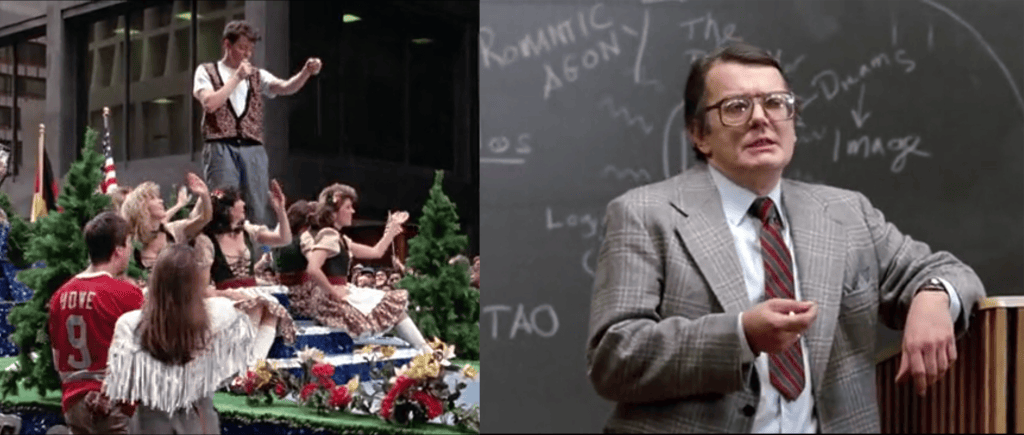
Students need more of the first, less of the second. (Ferris Bueller’s Day Off. Directed by John Hughes, Paramount Pictures, 1986)
My mom understood this. I remember numerous days when I was in high school and she could see that the rut of studying and reading and homework was grinding me down. When it got too bad, she would tell me to stay home from school. Not for any particular reason, but just to give me some time. I could go for a bike ride or read comics or watch crappy daytime TV or nap. The important thing was to do things that I chose, to feel that I had some control of my life. My mother’s wisdom in this is something I’ve carried with me into my adulthood – remembering that school and work are just ways to spend some of the time in my life, but they are not my life.
As educators, we need to be more like my mom, more like Ferris, and less like Ed Rooney. The way we can help young people is by giving them freedom to explore, to skip school for the baseball game, to sing Wayne Newton songs in a parade, to wander to the pictures in the museum that THEY want to see. Our Curiosity has served us in creating our understanding of the world. We must let their Curiosity do the same, not force ours upon them.
That said, their Curiosity may occasionally lead them to dark, despairing places, like Cameron found before the Seurat. He was there without an adult to support him. When I saw the painting as an adult, I had the benefit of Wisdom to help me make sense of the darkness. Similarly, educators can support student Curiosity by being nearby to supply doses of Wisdom when and where required.
Curiosity and Wisdom, it turns out, are complementary colors. When you place a touch of one beside the other and step back, it can reveal Truth.
In Ferris Bueller, despite the calls throughout the movie to “Save Ferris,” it seems clear that it is Cameron who is saved BY Ferris’ wisdom. But save also means “preserve,” and in that sense, I think we adults need to hold onto as much of Ferris’ loyalty and spirit of fun and wisdom of youth as we can, and stand ready to apply it as a counterpoint when our students struggle in their explorations.
Save Ferris.
