Category: Movies

  • Complementary Virtues, or Save Ferris

    Complementary Virtues, or Save Ferris

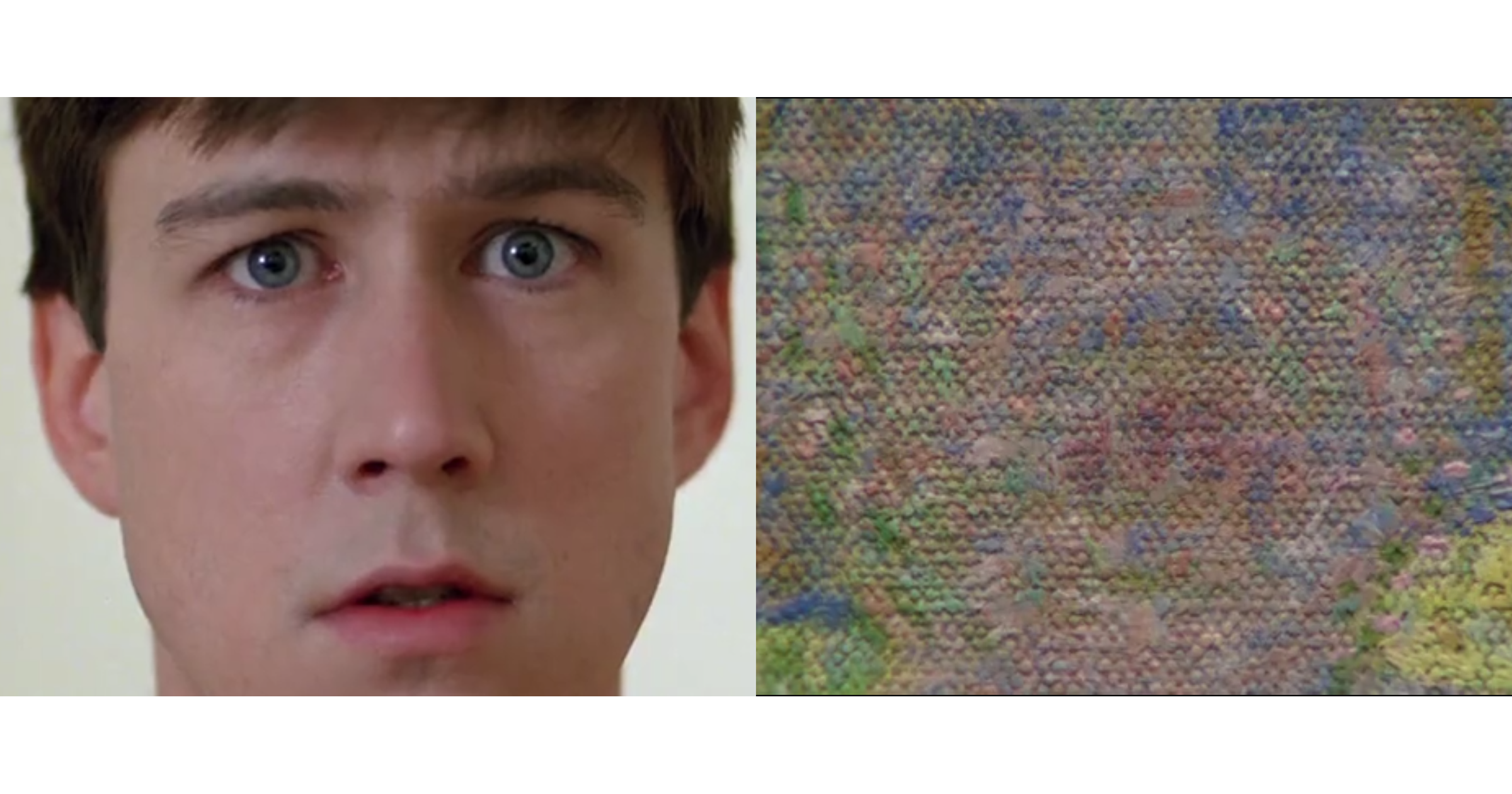
    In John Hughes’ 1986 classic Ferris Bueller’s Day Off, Ferris, Sloane, and Cameron visit the Art Institute of Chicago. Cameron, struggling in many areas of his life, finds himself standing in front of the Georges Seurat painting, A Sunday on La Grande Jatte – 1884. He fixates on a little girl in the center of the painting, finding something of himself in her, perhaps something he misses from his younger life, and he focuses hard on her, as though trying to extract it and regain it for himself.

    Of course, this is a pontillist work, and so the further into the picture Cameron gazes, the more the image dissolves into its constituent dots. The more Cameron “loses” the little girl, the more panicked he appears and the more his eyes grope at the picture, desperate to save the little girl from oblivion. After all, if he can’t rescue the little girl, how can he hope to save himself?

    This moment spoke deeply to me when I saw it as a teenager. Those of us who are honest with ourselves, I think, identified much more strongly with awkward, unsure Cameron than with effortlessly charismatic, miraculously lucky Ferris. I imagined the near-magnetic pull of Seurat’s work (only intensified when I saw Sondheim’s love letter of a musical), and I often wondered if, standing where Cameron stood, I too would feel myself separating into tiny colored particles, as a distant oboe hauntingly offered strains of “Please Please Please Let Me Get What I Want.”

    A few years ago, I finally had the opportunity to step figuratively into Cameron’s red Gordie Howe jersey. Often such moments, for me anyway, can suffer from a kind of patina of nostalgia that grows over the original memory. When reality scrapes away that coating, what remains sometimes disappoints.

    Not so Seurat’s masterpiece.

    The painting is in a different setting nowadays than it was in the movie, but that didn’t matter. Its pull is as wildly absorbing as I’d imagined – positively gravitational, fixing you in place before it. Questions materialize as you stare: how did I get here? why am I in the shade of the tree, when so many others sit in the sun? what is everyone looking at on the water? why are the woman with the orange parasol and her daughter not looking at the water, but staring at me? And yes, you find yourself pulled close by the gravity, realizing as your gaze drifts inward that your feet will never touch the grass on La Grande Jatte, because the grass, the hats, the animals, all is a lie: there is no green grass, merely thousands of blue and yellow dots and Seurat’s dark magic, his peculiar alchemy. If you allow it, you could let the truth of Seurat’s work dismantle you, just like Cameron.

    Seurat invented the technique of chromoluminarism, a painstaking approach to color that involved precisely selected groupings of colors which, when viewed by the eye from a distance, presented as an entirely different color. As Sondheim’s George sings while painting a black hat, “More red…/And a little more red…/Blue blue blue blue/Blue blue blue blue.” Seurat shows us in his art that what we see is NOT what we see – ours is a universe of lies. Lest we think him a villain for lying to us, consider that he at least confesses his fraud, lets us peek behind his magician’s curtain. Le menteur honorable.

    My experience with Seurat troubled me. I had, in appreciating a work of fiction (Ferris Bueller) taken from it a moment of emotional truth, connected to a genuine work of art in my world, the real world, not the film’s world. I thought that by making the pilgrimage to the work of art I could transfer the experience of that emotional truth from the character of Cameron to myself. Instead, I found myself preoccupied by Seurat’s deceit. I went seeking truth, and I came away with a lie.

    A couple months after my trip, Daniel Yon, director of the wonderfully named Uncertainty Lab at Birkbeck, University of London, and professor of cognitive neuroscience, released his book, A Trick of the Mind: How the Brain Invents Your Reality. In it, he explains that the purpose of our brains is to create for us the most detailed and reliable schematic of our world as possible. Curiosity is our brain’s magnifying glass, clarifying elements of our world-picture such that we can erase previous mistakes or fill in vague patches with crisper details. Where our curiosity has not been satisfied, we may struggle along with gaps in our picture for a time; while we do, our brain will fill in those gaps as best it can by extrapolating the most likely ideas and images to complete the picture.

    Viewing a somewhat impressionistic scene of a park, then, and seeing people sitting on the ground, our brain takes thousands of blue and yellow dots and says, “People in a park don’t sit on dots. They sit on grass, which is green. Let’s just make this green.” Similarly, when you see a naughty word written with asterisks on a page, your brain slots in the missing letters.

    Of course, in many instances, the brain’s guesses about the world are wrong. The brain, as Yon puts it, is your “skull-bound scientist,” and Curiosity is its intrepid research assistant, always seeking new data for review and inclusion.

    This idea of the “skull-bound scientist” made me think of the German philosopher Hans Reichenbach. He conceived a thought experiment somewhere between Plato’s cave of shadows and the Music of the Spheres. Imagine that we see the universe from inside a giant glass box. We see the moon reflected onto the glass, and we see trees and animals outside it, with their images appearing on the glass walls. At first, we believe that these flickering images on the glass are the actual moon or trees or animals. But over time, great scientists and thinkers demonstrate to us that these shapes have a reality all their own OUTSIDE the box.

    Now envision that glass box contracting until it is like a laminated layer around our skin. Our brain might still see a green patch of grass on the lamination, but outside that layer, there is a reality of blue and yellow dots. Our brains have receptors for data, but those receptors are imperfect. Rather than force us to cope with imperfect data, our brain “smooths the bumps” for us and shows us better images.

    And thank goodness it does! None of us are solid matter, after all – most of what makes up our bodies and buildings and rocks and bicycles and stars and oysters and cell phones and peanut butter and so on is just empty space, occasionally interrupted by tiny molecular dots that our brains pull together into the elements of our world. How terrifying for us if all we saw were the colored pegs of the Lite Brite floating in space, rather than the glorious, illuminated pictures those pegs become.

    I realized, then, that, rather than drawing me into a lie, the Seurat brought me to a deeper truth – how fortunate we are that our minds can craft such beautiful things from the chaos around us. Unlike what Cameron fears, we are never in danger of collapsing into an incomprehensible puddle of component parts – indeed, we are what gives the great puddle of the Universe its comprehensibility!

    Cameron, of course, can’t see this. The film suggests that his emotional sickness manifests as his physical ill health. His friend Ferris arranges a beautiful day of adventures and wonder, in hopes that he will realize all that the world has to offer him, and perhaps more importantly, all that he has to offer the world. Their day is full of the kind of exploration and education that simply can’t take place in school, and we see the joy of their day juxtaposed throughout the film with dreary scenes of their classmates trapped in their normal high-school schedule.

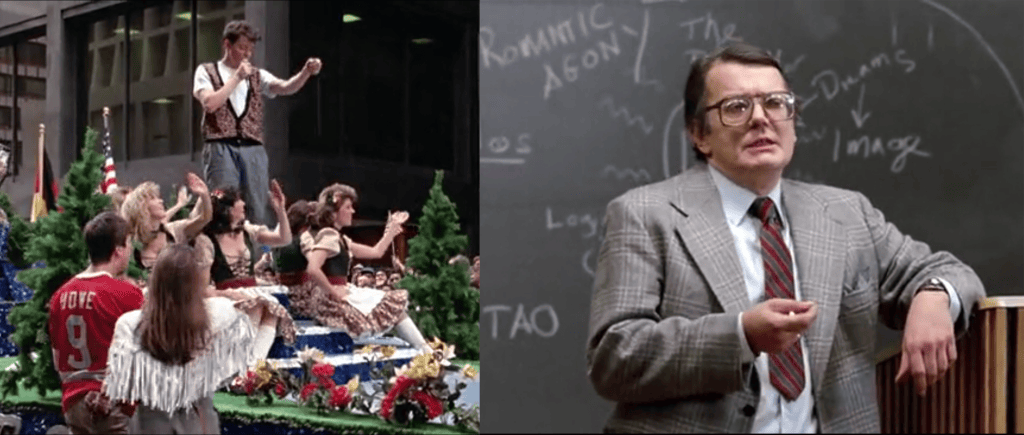
    Another key juxtaposition is that of Ferris with Ed Rooney, the dean at Ferris’ high school. While Ferris feels compelled to take advantage of a perfect day to help his friend, Rooney represents the persistent scholastic belief that the only path to a successful adulthood lies in desks and tests and lectures. Weirdly, Ferris demonstrates a kind of wisdom that Rooney lacks – Ferris understands that we need to be happy humans first, and only then can we be successful at anything else.
    My mom understood this. I remember numerous days when I was in high school and she could see that the rut of studying and reading and homework was grinding me down. When it got too bad, she would tell me to stay home from school. Not for any particular reason, but just to give me some time. I could go for a bike ride or read comics or watch crappy daytime TV or nap. The important thing was to do things that I chose, to feel that I had some control of my life. My mother’s wisdom in this is something I’ve carried with me into my adulthood – remembering that school and work are just ways to spend some of the time in my life, but they are not my life.

    As educators, we need to be more like my mom, more like Ferris, and less like Ed Rooney. The way we can help young people is by giving them freedom to explore, to skip school for the baseball game, to sing Wayne Newton songs in a parade, to wander to the pictures in the museum that THEY want to see. Our Curiosity has served us in creating our understanding of the world. We must let their Curiosity do the same, not force ours upon them.

    That said, their Curiosity may occasionally lead them to dark, despairing places, like Cameron found before the Seurat. He was there without an adult to support him. When I saw the painting as an adult, I had the benefit of Wisdom to help me make sense of the darkness. Similarly, educators can support student Curiosity by being nearby to supply doses of Wisdom when and where required.

    Curiosity and Wisdom, it turns out, are complementary colors. When you place a touch of one beside the other and step back, it can reveal Truth.

    In Ferris Bueller, despite the calls throughout the movie to “Save Ferris,” it seems clear that it is Cameron who is saved BY Ferris’ wisdom. But save also means “preserve,” and in that sense, I think we adults need to hold onto as much of Ferris’ loyalty and spirit of fun and wisdom of youth as we can, and stand ready to apply it as a counterpoint when our students struggle in their explorations.

  • True Curiosity Activation, a.k.a. Crowd-Pleasing Steps

    True Curiosity Activation, a.k.a. Crowd-Pleasing Steps

    I read this Substack post a couple days ago and noted with interest the way its point dovetailed with my own recent readings about the nature of curiosity.

    Looked at through evolution’s lens, from the moment each of us emerges into this life, our brain gathers as much information (sensory and otherwise) as necessary to understand the world around us, so that we can survive and thrive as a member of our species. The firmer our understanding of our world (or belief in our understanding of the world) becomes, the harder it can be to activate our curiosity – if our brain doesn’t feel certain information is “necessary” because our world view is complete enough, there’s a good chance our brain will ignore that information.

    So the job of education, then, is to gently, firmly, and consistently shake the worldview of the young. Calling their worldview into question activates curiosity, which is the bread and butter of deep learning.

    Then today I read a post on LinkedIn in which the writer talked about “…curiosity, the very thing we in independent schools work so hard to cultivate in our students. Turns out we need it too.” This gave me pause, for two reasons.

    First off, this highlights a central difference between virtue education and other forms of education: adults modeling the subject matter. There’s no real question of teachers obeying gravity outside the classroom, or calculating area in a radical way, or altering the plot of Hamlet. These subjects are fixed, regardless of adult action. However, if any school’s virtue education is just words unaccompanied by exemplar behavior, students will see it as at best unreliable and at worst hypocrisy. The research supporting this has been around since at least the 1960s, though Confucius himself told us in his Analects (5th-cent BC) that “a gentleman puts his words into action before putting his actions into words.”

    men and women in pruple and blue jumpsuits floating in a zero-gravity craft

    Secondly, hmmmm….working so hard to cultivate curiosity in our students…I guess I can appreciate this turn of phrase. After all, if you teach in a school with content-heavy curriculum, or with high-stakes testing (state tests, SATs, APs, Zhongkao, Gaokao, GCSEs/IGCSEs, A-levels, etc.), these require a high degree of predictability and focus in the classroom. Therefore, if you hope to cultivate a notoriously spontaneous and digressive trait like curiosity while satisfying the requirements of such curricula and testing, you will indeed have to work EXTREMELY hard, and I’m not sure how well that will ultimately go for you and your students.

    There is a tension between curiosity creation and the typical approach in a classroom. Concerned teachers who have not been trained to address this curious tension tend, in my experience, to attempt the next best thing – they try to impress upon students what it is that makes THEM curious about the subjects they teach. After all, the goal as stated above is NOT to cultivate the STUDENTS’ curiosity, merely to cultivate SOMEONE’S curiosity in our students.

    And so an English teacher with a love of Tennyson has her class read “The Charge of the Light Brigade.” Finding students unengaged, she might explain that she too, at their age, wondered what the big deal was. Was this poem even about a real thing? After all, if it was real and 600 people really died, that would be worth remembering.

    This might get a few students interested as she guides them into inquiries about the Crimean War, especially as it connects geographically and historically to the current war in Ukraine. Happy with their investment, she launches into a description of the situation at the Battle of Balaclava, where the poem takes place. She gently corrects some students who wonder if that’s where the name of the dessert comes from, explaining they’re thinking of baklava.

    As a small cluster of students begins discussing a recent TikTok where a chef made baklava, the teacher struggles to move forward, except now a student wants to know if this is where the clothing balaclava comes from. The teacher says she’s not entirely sure and anyway, that’s not really related to the poem. Other students want to know what a balaclava is, so the teacher has the inquiring student explain. While that happens, the teacher quickly searches and confirms that yes, the clothing is named for the town where the battle happened, which is just outside Sevastopol.

    Trying to get back on track, she asks the students to look for Sevastopol on a map and is surprised when a girl points it out almost immediately. The girl explains it is an important city on the Black Sea, pretty much due north of Ankara. Impressed with her geographical knowledge, the teacher asks her to explain what makes the city important. The girl, now embarrassed, explains that, in the European version of the game Ticket to Ride, it’s a major junction of four railways leading to different parts of eastern Europe, so it can be strategic to build routes to there when you play.

    As derisive and supportive murmurations begin to surface, the teacher returns to the battle, talking instead about the people involved, starting with the commander of the 600, Lord Cardigan. “Wait – CARDIGAN?” It’s the student who asked about the balaclava, now incredulous that another article of clothing has come up. Students start to wonder if this is a coincidence, or if there is more of a connection between this war and clothing in the 1800s. The teacher admits she has no idea – she doesn’t even know if Lord Cardigan has anything to do with cardigan sweaters. That’s not really relevant to the poem, though.

    Another student mentions that actually, there’s a long history of the military having an influence over fashion. He starts describing a podcast about clothes that did an episode a few weeks back about military styles. The teacher cuts him off to return to the Light Brigade.

    The teacher’s approach has clearly ignited the students’ curiosity on a number of occasions in a number of ways. But because their interest pulls focus from the material that she will likely use down the road for their assessment, she must worry about indulging their questions or connections. In any case, if she were to allow students to follow their own interests in the course of the discussion, she (the teacher) would likely not know the answers to their questions – how could she teach them, then?


    The situation reminds me of the 1992 Baz Luhrmann film Strictly Ballroom – in it, talented dancer Scott Hastings finds himself at odds with the dance establishment in his corner of Australia, the judges at ballroom competitions who oversee the network of dance schools and control the curriculum they teach with a fierce, conspiratorial grip. Scott, having mastered the material in his dance school, frequently finds himself artistically shackled, and allows his natural grace and musicality to interpret new steps, typically to the utter delight of assembled crowds.

    While Scott is motivated to find ways his art can delight and inspire others, his fellow dancers are motivated by achieving high scores and winning competitions. The dance authorities, meanwhile, realize that his approach to dance would completely upset their livelihood – how can you teach steps that are invented as a response to music in the moment? They insist that Scott stop attempting “crowd-pleasing steps” (their sneering, dismissive term for his dances) and stick to established, traditional choreography.

    Frustrated by the limitations of his dance-school world, Scott pursues his own research. His goal is not to abandon all categorization and structure in dance (remember, he has mastered all the steps taught in his school already). Instead, he finds teachers who reflect the culture and traditions from which the music and dances originate. Ultimately, when Scott performs his own improvised steps in competition, while they still do not conform to “Federation standards,” they more importantly reflect both the long history of the dance itself and Scott’s deep feelings about his art.

    Allowing students in our classes to go off-roading into topics brought up by the day’s activities would engage students, not least because they’d feel as though they were getting something THEY want, over and above what the curriculum demands. More importantly, it would demonstrate to them that we adults value their expressions of curiosity as much as our own. But how can we teach things we may not know?

    The key may lie in the Substack post I mentioned at the start: it describes the importance of asking the right questions to draw students into our lessons. I agree – and I would add that the right questions are those that connect student interests to the lesson material:

    • Granted, the baklava question was a misstep, but if there are students interested in food, what if we asked, “If we did an autopsy on one of the soldiers after the Battle of Balaclava, what might we find was their last meal?”
    • If there are gamers in the room, challenge them – “The deployment of French, British, and Ottoman troops at the battle ultimately overcommitted the British and led to the death of the 600 at the hands of the Russians. What if we set up all the armies as pieces on a game board…was there a way to defeat the Russians without the loss of so many?”
    • Fashion, for better or worse, can be one way to prove the lasting impact of a historic moment. “This was one small battle in a little-discussed war over 170 years ago. But we still talk about it – we have poems and movies about it, and names from it are in our everyday vocabulary. But which of these is the MOST important cultural leftover? Let’s fight about it!”

    All of these questions could then be followed by guided periods of research and discussion where we help students find the things they want to know about the things we want them to know.

    Admittedly, this is not a complete plan for building students’ curiosity – it is merely one step. But, I feel confident that it would be a crowd-pleasing step.

  • The Hugging Face Situation,
or
When We Leave Our Brainchild Home Alone

    The Hugging Face Situation, or When We Leave Our Brainchild Home Alone

    I recently read Cory Doctorow’s piece on Medium, “LLMs are real, AI is Fake,” in which he beautifully dismantles the alleged “threat” posed by the LLMs of tech companies like Anthropic and Open AI.

    (just to be clear – he’s not suggesting these companies pose NO threat to humanity, merely that it’s not the threat they want you to think they pose; for a sobering summary of the ACTUAL threat posed by AI, please see Naomi Klein’s Substack on “Fossiltech”)

    Citing loads of people in the tech industry, Doctorow posits that it is wrong to constantly refer to these Large Language Models as “artificial intelligence,” because while much about them is artifice, precious little is in any way intelligent. At least, not in the way we humans understand and appreciate intelligence.

    I’ve been thinking a lot about this since I finished his essay, largely in the context of my recent reading on curiosity. I’ve read articles in which members of the tech community seem to suggest that LLMs demonstrate a kind of curiosity. Unless you define the word in a one-dimensionally mechanical way, this simply can’t be true.

    My understanding of the Recent Scary Thing, according to Mr Doctorow (who is referencing a podcast with Ed Zitron and Cal Newport), is that OpenAI wrote a relatively simple Python program that controlled prompts for an LLM. The assignment was to get the LLM to attempt a hacking challenge. So it set up a prompt asking how to do the challenge; we’ll call this string H. The LLM went through old records of hacker challenges and returned response R. The program then said, “H now equals, ‘assume R, then H’; go to start and repeat.” And it kept doing this until Bad Things Happened.

    Oh, also OpenAI deliberately left its sandbox for the experiment slightly open. And so the Badness Escaped.

    Nothing in here resembles intelligence – ultimately, the LLM stumbled on a bit of an old challenge where actual human hackers snuck into rival systems in pursuit of their own goal. The LLM, which runs through every possible permutation of events to find next steps, found this example from the human hackers and recommended it to the brainless program running it, to which the brainless program said, “Okay, yeah, now do that.”

    It wasn’t because the Python code thought to itself, “Hmmm…I wonder what would happen if I tried this?” The code and LLM were no more interested in seeing what might happen for the sake of it than the chatbot I typed with the other day was interested in helping me sort out the tech problem I’d been having on its parent website.

    Its questions, like those of the OpenAI system, were repetitive and relentless and displayed zero concern or interest. Like Larry Hankin’s magnificent Sergeant Balzac in Home Alone when Kevin’s mother calls the police station, he asks her questions about Kevin NOT because he is interested in finding out what is going on with her son (he clearly isn’t), but because it’s specifically what he has been told to do, using specific prompts he has been given.

    In fact, when Kevin’s mother suggests that Sergeant Balzac demonstrate a little curiosity about her son, by going to the house to check on him, it’s more than his program can handle, so he transfers her to someone else.

    Programming, it seems, has its limits, and stops short of behaving in a human way.

    Genuine curiosity, on the other hand, is much better represented in the McCallister’s neighbor, Mitch Murphy, who wanders over to the McCallister house as the two hired drivers are loading up the vans with the family’s luggage. Mitch talks almost the entire time he’s on screen, asking a question an average of every 11 seconds: “Did you know they’re going to France? Do you know if it snows there? Do these vans get good gas mileage?” and so on.

    While one could argue that his sheer relentless assault of questions verges on the mechanical, we know he comes from a place of curiosity because, after both drivers send him away (“I told ya, kid, don’t bother me!”), he climbs into the back of one van, and decides to open a bag to see what’s inside. He pulls out a camera and a yoyo and explores how they work.

    (this mirrors Kevin’s own behavior throughout the movie, asking the lady in the drugstore, “Is this toothbrush approved by the American Dental Association?” and the cashier in the supermarket, “Are these frozen dinners any good?” to say nothing of his exploration of Buzz’s foot locker and shelves)

    It is as Mitch engages in his act of curiosity that Kevin’s older sister accidentally counts him as one of the McCallister children. Curiosity, it seems, is the behavior that allows us to imitate other humans.

    So that’s a secondary reason we should actively work to cultivate curiosity in our children: because it will strengthen them with a skill AI can’t match. But the far better reason is that curiosity leads to compassion, connection, and kindness.

    It’s Gus Polinski’s curiosity that causes him to inquire what it is that’s making Kevin’s mother so upset at the airport; when he learns her problem, he offers to help.

    It’s Old Man Marley’s curiosity that leads him to sit with Kevin in church, allowing him and Kevin to become acquainted – their conversation ultimately results in Marley saving Kevin from the Wet Bandits, and in Marley’s happy reunion with his son and granddaughter.

    For their part, the Wet Bandits show us what happens when adults, like LLMs, behave uncuriously, acting solely on want, following the same relentless patterns of behavior, taking things without being interested in them, invading people’s lives without any desire to know anything about those people. And like LLMs, Marv and Harry wreck neighborhoods and waste an astonishing amount of water.

    So, let’s not consider the Mitch Murphy questions a bother. Let’s raise more Polinskis and Marleys, and fewer Marvs, Harrys, and Balzacs.

    Our children are our future. We must defend them.

  • Content Development vs Content Development

    Content Development vs Content Development


    A couple years ago, my wife and I had the chance to fulfill a decades-long dream of visiting Australia. There are a hundred stories worth telling from this trip, but for now I will limit myself to a single happy encounter during our stay in Melbourne.

    Let me preface this by confessing that I can be a tedious person with whom to travel. When I arrive in any city, my first priority is locating any and all bookstores (or even stores of other varieties that may contain small sections of books) and spending as much time in them as possible, attempting to commit their selections to memory for future reference. You can tell a lot about a city from its bookstores, and you can tell a lot about a bookstore based on what it chooses to stock.1 It behooves one, then, upon arriving in a new place, to map and gene-sequence the book suppliers in order to fully understand the Municipal Organism.2

    Melbourne presented itself as a very fine book city, and one strand of protein we stumbled upon was the Hill of Content bookshop on Bourke Street, a cozy place with a richly rewarding variety of books available. Having opened over a century ago, it is Melbourne’s oldest book emporium.

    So much did I enjoy my time in their establishment that I chose to purchase one of their branded totes as a memento. The totes draw attention to the persistent mystery of Hill of Content: where should one put the emphasis? Is it the “Hill of CONtent” bookshop, conjuring up an image of an enormous mound of books? Or is it the “Hill of ConTENT” bookshop, evoking the sensation of quiet pleasure, joy, and satisfaction one often derives from a well-selected volume and a relaxing session of page-turning? No one can say for sure, and the debate rages on.

    The more time I’ve spent with this bag and its provocative question, the more I’ve come to believe the same question plagues the world of education. Overwhelmingly, schools seem to be measured by their ability to deliver content, rather than contentment, to students.

    In fairness, I know of a great many schools with powerful academic reputations that have worked diligently in the past ten years or more to address concerns around student stress and to promote well-being. Schools want their learning environments to be enjoyable spaces for young people. Many that I know provide “mental health days” with breaks from class, counseling sessions, even therapy dogs. Some have created “intersession” days during the school year, where students and teachers stop working with the normal curriculum and instead spend time on non-graded, new activities like pilates, crossword design, tae kwon do, knitting, model rocketry, or baking. Schools have tried to increase the individual time students have to talk about how they’re feeling; to this end many train older “peer counselors” who help by talking about how they coped when they were the age of younger students.

    But…

    Most schools still employ a specific mandatory curriculum, one that generally offers little by way of choice, particularly among younger ages. Most schools still utilize exams or tests of one sort or another as their primary mechanism for assessing student achievement of curricular standards. Most schools create tiered classes in at least one subject, which can have the effect of lumping the highest-performing students (from a conventional GPA standpoint) together in other – even all – subjects. Most schools encourage competition either through class rankings (to determine, ultimately, valedictorian and salutatorian awards) or through academic prizes of various sorts. Most schools want to be able to tell families that 100% of their graduates end up at a four-year college, and that a significant percentage of those graduates attend “extremely selective”3 universities.

    It seems clear that removing any one of the above items as a school priority would go a considerable way to alleviating the stress felt by students. But I know when I write those words that most people find this idea laughable – even grossly negligent. Ambitious parents hope that schools, ultimately, will enable their children to compete and win places at selective universities; most believe this means enabling their children to achieve high grades and to win prizes that look good on college applications. Schools point out that universities and the work force are competitive situations, requiring students to demonstrate what they know and to try to edge ahead of others for limited opportunities. For a school NOT to prepare students to enter the real world would be criminal.

    No doubt you, like me, see the situation as reminiscent of that iconic moment in Star Trek II: The Wrath of Khan.


    We learn in Nicholas Meyer’s 1982 sci-fi masterpiece that Starfleet cadets seeking command positions are required to take part in the “Kobayashi Maru exercise.” This is a kind of role-playing game in which the applicant assumes command of a starfleet ship that receives a distress call from another (the Kobayashi Maru of the title) in enemy territory. Approaching to provide assistance, the applicant finds him/herself attacked by three enemy vessels and quickly outmaneuvered and outgunned.

    The game is designed to be unwinnable, intending not so much to test battle strategy as to evaluate how the would-be captain faces up to certain death.

    Only one cadet in the history of Starfleet has ever “won” – come out of the Kobayashi Maru exercise with his ship, crew, and person intact: James T. Kirk. We learn later in the movie that he won by sneaking into the simulator the night before his test and reprogramming the scenario so that there was a path to victory.

    Effectively, then, as Kirk’s son points out, he cheated.

    College game theory classes love putting students through these types of expansive thought experiments. The Prisoner’s Dilemma is a typical example. In it, two prisoners accused of the same crime are interrogated separately. If Prisoner A “confirms” (rats on Prisoner B) while Prisoner B “denies” (says nothing), Prisoner A goes free and Prisoner B serves 5 years in prison. If both confirm, they each serve 3 years in prison. If both deny, they each serve 1 year in prison. So if you’re Prisoner A, what should you say to the police, if anything?

    When I first read about this game, I remember having the feeling Kirk must have had when faced with the Kobayashi Maru: what a lousy couple of choices. Let 300 people die on the stranded ship, or lead my own ship to certain doom? Speak up and likely face 3 years in prison, or say nothing and risk a 5-year sentence?

    The Prisoner’s Dilemma asks us to turn philosophical considerations about our control over our personal freedom into some kind of minimum-information problem. In the situation, am I not guilty? What was the crime? Do I know for sure that the other prisoner did it? Is there evidence to defend the charge? If I’m in prison for 5 years, is there any chance of early release? Do I have a lawyer? What is s/he recommending?

    I realize that asking these questions obscures the purpose of the game a bit (i.e. calculating best options in a linked-outcome situation when you have no information about the other linked choice), but the alternative is allowing a conversation around criminal justice and sentencing guidelines to be reduced to a statistical function, which I find problematic.

    Like Kirk, I wanted to reprogram the game.

    Returning to the question of schools and student mental health, I feel the whispers of the Kobayashi Maru in my ears again: what a lousy couple of choices – either enable systems that produce inordinate stress in young people, or send them into their futures largely hobbled in their ability to lead “successful” lives.

    Why are these the only choices?

    In virtually all the books and essays I’ve come across regarding the Prisoner’s Dilemma, it is treated as a problem of rational thought vs irrational thought: the way to avoid the longest sentence (5 years) is for each prisoner to confirm, though doing so will mean they each serve 3 years. On the other hand, if each does the irrational thing, they will both serve only 1 year. Most analyses discuss navigating the tension between rational and irrational decision-making.

    No discussion of guilt, or the law, or evidence, or justice, or responsibility, or freedom, or conscience, or loyalty,4 or due process – all of which would form a part of pretty much any person’s decision-making were they to find themselves in this actual situation. The game asks us to remove important questions of human values from the equation – and then to take what we’ve learned and apply it to real-world situations. Which implies that we should also, what, disregard human values from the real-world situations as well?

    Similarly, in the Kobayashi Maru scenario, cadets are asked to look past the hundreds of lives that would potentially be lost (including their own)5 and to somehow engage with the “leadership lesson” being taught as they make a series of futile commands in the fleeting final minutes of their simulated existence.

    Kirk understood even one lost life can be an onerous burden, let alone hundreds. The fact is, if a no-win situation like Kobayashi Maru comes our way, no amount of preparation will change the ending. So, Kirk rightly considers, how is it a good use of time to practice this ending, when we could instead put that same energy toward finding ways to AVOID these no-win situations?

    (Incidentally, “Kobayashi” is one of the most common surnames in Japan, roughly as common as Davis in the US. “Maru” is a common ending word for ships, used to denote perfection and safety. But read literally, the phrase “kobayashi maru” can mean “small, round forest.” Throughout Star Trek II there are a number of small, round settings–including an underground forest of sorts on a distant moon–frequently used as spaces where characters face what appears to be certain death. On several occasions, Kirk finds his way out of these “small, round woods” with unconventional thinking.)

    What if the lesson of the Prisoner’s Dilemma involved teaching game theory students how to identify analagous situations in other areas of life and work, and then how to ensure that the decisions made – by both the prisoners and interrogators – are based in strong morals and ethical behavior? What if the Prisoner’s Dilemma encouraged students, in matters of justice and freedom, NOT to be reductionist in our thinking, limiting our decisions to a single data point like, “What’s the other guy gonna do?” What if instead, it taught that decisions around weighty matters deserve lengthy, complex deliberations? Deliberations that reference connecting concepts (e.g. freedom) and fundamental human values (e.g. justice)?

    Again, I can practically hear the eye-rolling of those who feel that I’m being purposefully obtuse – I continue, some will say, to miss the whole point of the Prisoner’s Dilemma exercise. I would prefer to say that I haven’t missed the point, I have simply tried to substitute it for a point that is far less dangerous.

    Yes, that’s right: dangerous.


    I recently read an interview with the environmental writer and analyst Ketan Joshi. Mid-way through, the interviewer (Vlad Bunea) pointed out a number of things:

    “There are a lot of reports (1, 2, 3, 4) that tell us how bad the climate crisis is. If we were to use a metaphor it appears they are describing the water while we are drowning in it. They do not take a stance against the extra-scientific causes for these terrifying realities even though this would be perfectly well aligned with the scientific method.”

    (Sufficiency and Wellbeing Magazine, 15 Mar 26)

    Among the causes the reports could have identified are the corporations who knew that ongoing, mass use of fossil fuels on a global scale would produce precisely the environmental effects we’re seeing now.6

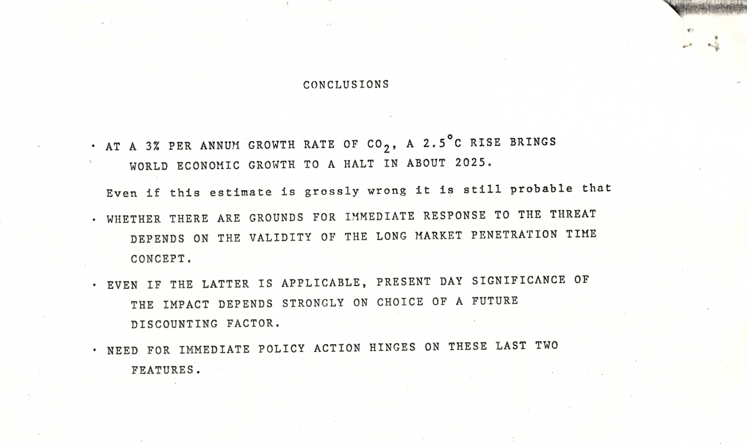
    As early as 1959, renowned physicist Edward Teller addressed a conference of petroleum executives7 and told of the dangers of the “greenhouse effect” from burning their products. In 1965, at a meeting of the American Petroleum Institute, their president, citing a study by US government advisors, warned of “catastrophic consequences” due to the increase in CO2 levels, causing “marked changes in climate” by the year 2000. That same organization created a “CO2 and Climate Task Force” in the 1970s, with members from major oil companies, that foresaw ongoing fossil fuel use causing “globally catastrophic effects” in the 21st century; then the API hid their findings from world governments, advising them instead to dramatically increase their coal consumption. Exxon leadership received (and widely shared) a memo from one of its own managers linking their business ambitions to a catastrophic future for large portions of the planet.

    The fact that all this happened (we have detailed evidence of the deceptions), but scientists don’t feel they should talk about these things as root causes of our current situation feels very Kobayashi Maru/Prisoner’s Dilemma to me.

    More fundamentally, as an educator, I feel as though those of us adults charged with guiding young people (who suffer increasingly from anxiety and mental health concerns related to the environment)8 into the future are Starfleet offering up the no-win situation, asking them to accept that people are going to die no matter what choices they make. We are game theorists telling students to be rational and accept one of a few bleak futures. We know that there are others making decisions entirely connected to the bleakness of students’ futures, but we don’t really talk about that. We don’t discuss the future with them from the standpoint of responsibility, or truth, or evidence, or justice, or even the law.9

    Instead, we teach them to be resilient, we offer them mindfulness exercises, we encourage them to cultivate “the perspective that comes from realizing the potential of recovery and rebuilding.” Which feels to me a bit like telling Starfleet cadets, “The Kobayashi Maru is a situation you will probably encounter at some indistinct point in your future; you’ll see it coming and be powerless to stop it,” and then providing them with grief counseling.

    It can make young people believe that we adults aren’t really interested in changing the way things are or improving the way the world works for them. And, when we then train them up to go through a college application process fairly indistinguishable from the one their grandparents experienced10 (swapping out computers for the paper-and-pen process of yesteryear), the sense that adults want to keep everything just like it is feels profoundly reinforced. Such experiences can affect students’ trust in educational institutions, to say nothing of their joy, motivation…even hope.

    But…

    What if we cheated?

    A few months ago, Cory Doctorow wrote a piece in which he pitted William Gibson’s quote, “The street finds its own uses for things,” against Margaret Thatcher’s line about liberal capitalism, “There is no alternative.”

    Thatcher’s point was that, if you want to have the nice things that we have in our world, then we have to accept the bad stuff that goes along with it. Do you like having cars? Well, then, we’ll need to bleach the world’s coral reefs. A fan of air travel? That means you don’t care if the ice caps melt.

    Doctorow argues that this is, like the Prisoner’s Dilemma, a reductionist point of view and suggests that Gibson’s observation offers a strong counter to Thatcherist thinking. Gibson points out that, no matter what you intend when you make a doohickey – a new technology, a movie, a tool, anything – no matter what you tell people it’s for, once they get hold of it, they will do with it what they please.

    Your novels will spawn thousands of pages of fan fiction, taking characters places of which you never dreamed. Your nail polish remover will become an antidote for SuperGlue mishaps. Your duct tape will produce a functioning wallet while your yellow packing tape will fashion articles of clothing. Your explosive will make a useful heart medication. Your under-oven food-warming drawer will be repurposed for storage.

    Effectively, like Nathaniel Hawthorne’s Owen Warland in “Artist of the Beautiful,” once we release our exquisitely-engineered mechanical butterfly into the child-like hands of the world, we are powerless to stop the world from grabbing it and breaking it into its component parts. And then using those parts to make a lockpick or a trap for spiders or a mechanical page-turner for sheet music.

    Put another way, once the street gets hold of cars, they’ll invent loads of ways to reduce greenhouse gas emissions, well beyond electric cars. Same with air travel.


    So what if, in our schools, we offered our students the World with the expectation that they should do something radically different – and radically better– with it?

    What if we treated our young people like wily Kirks and not doomed cadets? What if our education showed them the alternatives Thatcher denied and celebrated them as members of Gibson’s “street”? Our interrogators would offer the Prisoner copies of all the evidence and connect them with a great criminal defense attorney. Our Starfleet would hand Kirk the wiring diagram for the simulator and a bag of tools. And then explain what each tool is and how it can help revise the no-win situation.

    The tools we must supply are many, myriad, and complex: our students must gear up with a sense of justice, responsibility, conscience, loyalty, compassion – all values that will enable them to identify problems that need correcting or avoiding. We must show them how to employ imagination, collaboration, open-mindedness, and resilience, so they can work together to find solutions to big problems. They’ll need to put in hours of training on reason, healthy skepticism, forgiveness, trust, and self-awareness to test themselves and their ideas and to own their mistakes.

    This is a partial list of building blocks of a new curriculum. And what texts should we select?

    We could introduce students to Michael Reynold’s Earthship design concept for sustainable homes, which has evolved and improved and spread since he conceived it in the 1970s. We could immerse them in hopepunk, afrofuturism, and other artistic movements imagining positive outcomes stemming from troubled pasts. We could encourage them to listen to the Upstream podcast as a way to come to grips with alternative economic models that might be better suited to a sustainable, equitable future. We could point them toward their local officials who could enact worthy changes close to home.

    We could do all this and more. And maybe our students wouldn’t notice or wouldn’t care. Maybe they would just leave the world on its current trajectory.

    Certainly, if we cling to the familiar well-worn paths that schools have always followed, the odds of our students doing the same increase.

    But if we show them other paths, and if we give them useful tools and knowledge, and if we cheer them on as they leave the spaces we find comfortable, they might explore different paths through the small, round woods into the future – not without pitfalls and dangers, but with the benefit of being NEW and rich with POSSIBILITY.

    This said, I should amend my thesis for this little diatribe. Not that I don’t want the children of today to find a measure of inner peace – I absolutely do. But, as Rutger Bregman says in his preface to Moral Ambition, complacency is a poor fertilizer for the seeds of change. In our warming world, we must help rising generations find and inhabit their winter of discontent, using the tools of character to dismantle the world we’ve offered them and to build an entirely new, better one for themselves.


    In this blog and the accompanying podcast, The Children Who Will Change the World, I explore edits to our educational approach – some tiny, some rather larger – to make small tweaks that might lead to big tweaks that might lead to cultural shifts and to young adults emerging from our schools with a human toolbox at their disposal that’s as impressive as their academic one. Put another way, let’s do more content development aimed at developing some virtuous contention in our young people.


    1 I’ve got a whole theory about this – but that’s fodder for a future piece.

    2 Time should also be spent investigating and cataloging restaurants for identical reasons.

    3 Defined as colleges and universities who accept less than 15% of their applicants.

    4 What even IS the relationship between the Prisoners supposed to be? Why were they picked up together for this crime? So very many questions…

    5 Cadets in the simulation are assured that the enemy ships will wipe out everyone, effectively making this, then, the “No Prisoners Dilemma.”

    6 All information in this next section comes from Jonathan Franta’s excellent 2021 article in The Conversation, “What Big Oil Knew About Climate Change, In Its Own Words.”

    7 Energy and Man, “Energy Patterns of the Future,” pp. 56-58.

    8 Another useful article from EdWeek, 2022 – “Teens Are Struggling With Climate Anxiety. Schools Haven’t Caught Up Yet.”

    9 Indeed – when schools dare try to encourage students’ civic engagement on such matters, many accuse them of “making school political,” “promoting a left-leaning bias,” “brainwashing young people,” and worse. Schools can face hostile parents and even lawsuits which ultimately require the academic “both-sidesing” of an issue that almost the entire scientific community – as well as many oil company executives and almost all insurance companies – accepts as real.

    10 No joke – the US Common Application was first offered in 1975 – and early admission has been around since the 1950s. In China, the current Gaokao (university admission test) was implemented in 1977, though the Gaokao has existed in some form or other since 1952. Although the UK’s UCAS system has only existed since 1993, it emerged in part from the UCCA system begun in the 1960s; both systems have always relied heavily on A-levels and comparable high-stakes testing in determining university admission.