
The following is an amended and slightly updated version of a piece I wrote many years ago, in which I outlined some of the roles that community and ethos play in the virtue education of young people. Looking back on it, I might say that this was an early draft of my thoughts on the holistic approach required for true virtue development.
The other day I read a short online bio of a TV presenter I’d gotten to know when my family moved to London in the late 90s. He was an American who had spent some time as an undergraduate at the London School of Economics; having enjoyed this experience, he spent even more time at Cambridge earning a Masters, then a doctorate. In the bio, he explains that from the moment he arrived in the UK, he felt like he belonged there – like he’d always been missing a piece of himself, and he found it in this other country that he’d never visited before. He describes it as a very strange sensation, but ultimately a comforting one.
I’ve had this experience once or twice in my life. I visited a school for a job interview a long time ago and immediately sensed something entirely different about it. It was hard to put my finger on, but I remember thinking of the scene in Being There where Chance (Peter Sellers) walks into the hyper-oxygenated room of the dying Ben Rand (Melvyn Douglas). Having never encountered such rarified air before, Chance inhales deeply, smiles, and says, “I feel very good in here!”

Chance the Gardener takes the air at Rand Memorial Hospital (Being There, directed by Hal Ashby. Lorimar Productions, 1979)
As it happens, I learned that the first head of that particular school I visited had always intended to create “a place where it should be easy to be good.”
That was how I felt there – I felt good. Whole, embraced, known, content. In just my first day, I sensed that everything about the school – the people, the buildings, the lush greenery – wanted me to become the best version of myself.
Thus, I seemed to confirm (albeit as a data point of one) that that first head had succeeded in his ambitions. But if what I sensed was true, how did such a place come to be? It seemed to me that you couldn’t make people improve morally and ethically without a plan for virtue education; that said, how could any virtue education plan be successful if it wasn’t the product of an already good place? A bit of paradoxical pedagogy, or perhaps more a pedagogical paradox…
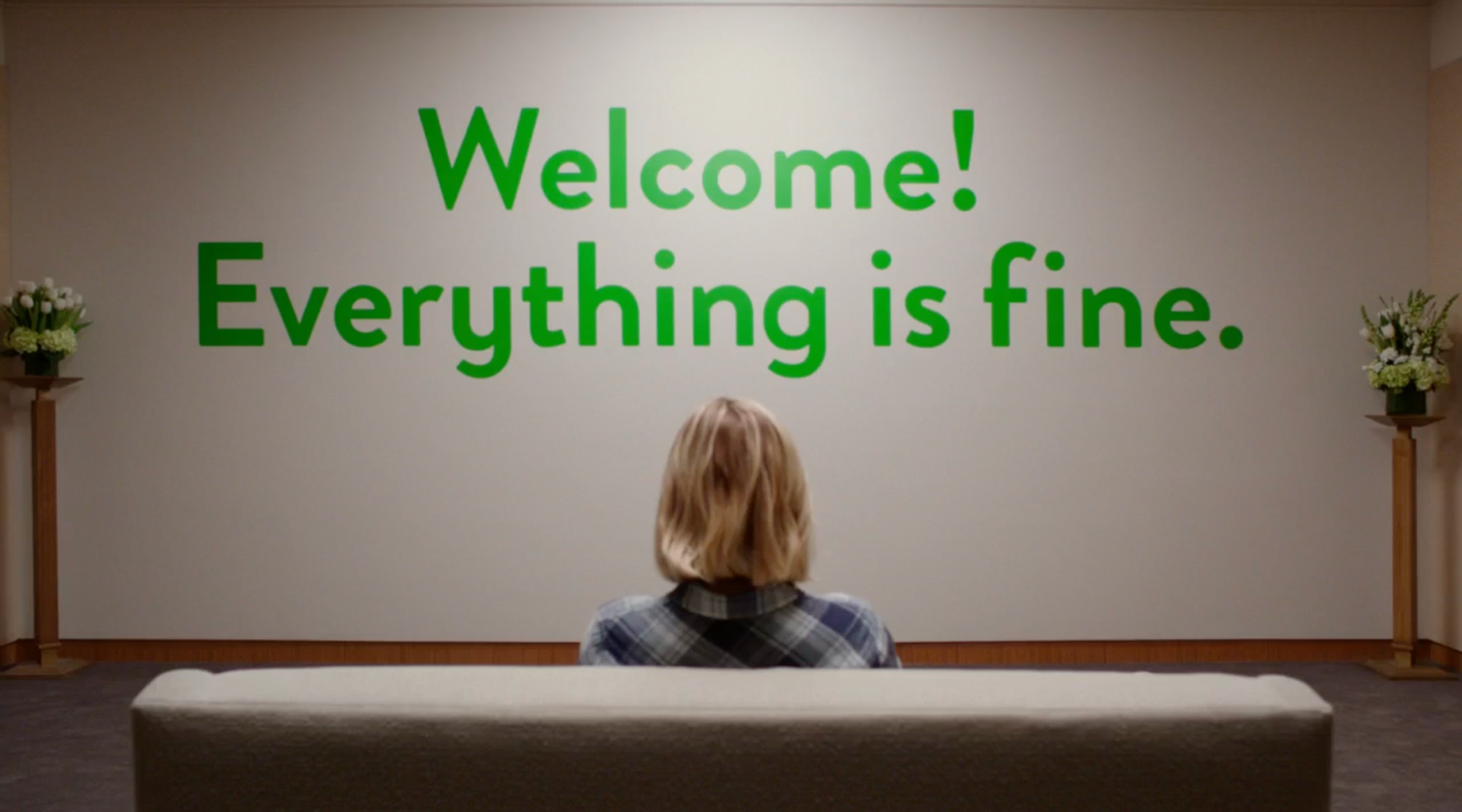
From 2016 to 2020, NBC aired a delightful sitcom about virtue education, The Good Place. Okay, no, it wasn’t billed as “a sitcom about virtue education,” but that doesn’t change the fact that this is EXACTLY what it was, and over the course of its four seasons, creator Michael Schur’s beautifully implausible brainchild offers, I think, a possible blueprint for transforming schools into places where it should be easy to be good.
“…Someone Like Me as a Member”
– the ninth episode of The Good Place

‘If he likes me, doesn’t that make him seriously messed up?’ Eleanor thinks (“…Someone Like Me as a Member,” The Good Place, created by Michael Schur, Season 1, Episode 9, Fremulon and 3 Arts Entertainment in association with Universal Television, 2016)
In the first episode, the late Eleanor Shellstrop arrives in The Good Place, the final destination for all “good” people. It’s paradise, and she knows there has been a mistake. She has not been good, and she doesn’t belong there. Realizing that unless she learns to be a good person she will be sent to The Bad Place, she asks the first friend she makes, Chidi, to teach her how to be good. Unfortunately, Eleanor has lived her life pushing people away, especially those who offered an outstretched hand and a sense of belonging, and she can’t stop herself in the afterlife. She distrusts Chidi’s kindness and support, even as her deception is revealed and demons from The Bad Place arrive to take her away. Only when she confronts her past isolation and understands it to be a kind of self-punishment does she begin to grow and see herself as deserving of the care and affection of others.
Recently I happened across a post online by a career educator with a deep background in boarding schools. The post trumpeted the value of teaching young people true independence – self-reliance, the ability to sort out your own difficulties without anyone to help you. While I understood his point, I found it an odd one coming from a boarding school advocate. The best boarding school experiences, I think, don’t teach independence so much as interdependence – you learn to find your people and to rely on them to help you through tough times. And, in turn, you build a sense of responsibility to be the sort of friend and community member that others can turn to and rely on in their times of need.
While working at a boarding school many years ago, I bumped into a new student and asked him how things were going on his hall. “Yeah, good, I’m relieved to say,” he told me.
Why relieved? I asked.
“Well, things didn’t have to be good,” he said. He explained that once he got beyond the structured activities of move-in day and orientation, all of which were great, he expected that when the adults weren’t looking, it would be different. He was worried about the first time he went to breakfast in the dining room all by himself. But, he says, “I got my food and I walked over to a table with these four other boarders sitting at it. I said, ‘Is it okay if I sit here?’ They looked at me like I was nuts. ‘You don’t have to ask,’ they said. ‘You just sit down.’ That’s when I knew it was going to be good.”
The students were, of course, kind in letting him know he could sit at their table. But I also now see that the new student needed to ACCEPT the kindness and friendship offered to him–and that was brave.
A few years later I was the advisor to a new student who came to the school unwillingly, at the insistence of his parents, while all his friends attended the local public high school. “There’s nothing wrong with this place, Mr McColl,” he’d say. “The kids here are all incredibly nice. They always include me in the stuff they do. The teachers are great as well. But I just don’t think I can be happy in this school knowing my friends are at another school.”
Time passed, and the student joined the basketball team. He softened, opened up to his teammates, and they became his brothers-in-arms. He laughed more, dropped his guard.
The first day back from winter break, he poked his head in my office to say, “Hey, Mr McColl, I wanted to let you know – I’m good now.”
I see now that this young man arrived at school, in part, unready to be a friend – unable at first to accept the friendship and inclusion that was being offered to him. Why might this be?

Groucho Marx once famously remarked, “I refuse to join any club that would have me as a member.” Our own latent sense of our unworthiness sometimes leads to initial suspicion of those who are kind to us, and we don’t accept the offers to be included. We don’t take a seat at breakfast. We don’t think we belong in such a good place.
But good places remain patient. They continue to offer and include. We know that those new to our place need time to trust the good in themselves that others know and embrace without doubt or question. Acceptance of others’ belief in us happens on different schedules for different people; as distance remains while acceptance matures, it is important for the community not to judge. Ultimately, it becomes easier to be the friend others see in us. It makes it easier for us to be “good now.” Until that time, though, all a good place can do is keep a friendly hand outstretched and wait.
“The Trolley Problem”
– the eighteenth episode of The Good Place

When is a thought experiment NOT a thought experiment? (“The Trolley Problem,” The Good Place, created by Michael Schur, Season 2, Episode 5, Fremulon and 3 Arts Entertainment in association with Universal Television, 2017)
By the second season of The Good Place, the core characters face the reality that they are each imperfect, but still worthy, and they realize that personal success is not success at all if it comes at the expense or loss of friends. One episode explores the challenges of making ethical decisions, using the classic “Trolley Problem,” as framed by English philosopher Philippa Foot: in it, you are the driver of a trolley heading toward a group of four workmen who don’t see the trolley coming. To avoid killing all of them, you could switch tracks, but in that instance you would still kill a lone switchman working on the second track. How do you negotiate the nuances of the choice involved?
One truth the Trolley Problem seeks to illustrate, I think, is that no matter what decisions we make about our behavior, they will have consequences for those around us. The Trolley Problem asks, “When we choose what we do, how are we thinking of other people?”
I was once told a (possibly apocryphal) story about a legendary high school girls’ soccer coach which illustrates this question beautifully. According to the story, this coach started each season by bringing the team into the woods to find a felled tree. He’d instruct them to pick it up and begin walking with it. As they did, he explained that, should any one of them wish, they could stop carrying their weight – literally. They could keep their hand on the trunk but not support it. No one else would know. But, he pointed out, that’s not how a team succeeds. A team succeeds because everyone makes choices that contribute to that success.
The Trolley Problem is all about the relative pain our decisions create – some are more destructive than others. The soccer coach’s variation on this theme allows for the variability of benefit: if I’m taller and stronger, I can choose to carry more of the log than others. No one will know except me, and I will do it because I know it will make things a little easier for the rest of my team. The coach was teaching his team that being good to one another, living in a good place, means understanding that lifting more or less of the tree doesn’t in and of itself make us “better” or “worse.” Good choices involve seeing our peers’ need of us on a spectrum and appreciating where they and we sit on that spectrum.

Of course, I suppose you could also choose to walk on the tree instead of lifting it… (© 2025 Peter Cooper Jr. / Wikimedia Commons / CC BY-SA 4.0)
A student I knew spent the first half of her year in Grade 8 math earning grades in the 70s and 80s. “Just once,” she told me, “I want to get an A.” One day in late January, it happened – I found her at lunch jumping up and down, celebrating with her friends. “I got a 92!” she exclaimed as her friends hugged her and yelled.
I knew most of those girls, and I strongly suspect that at least one of them did better on that test. But none of them said so. Instead, they revelled in – and became a true part of – the girl’s success. They understood that accomplishment is relative: a 92 that culminates months of work can be worth more than the 98 that is easily earned. Her friends made the good choice to hide the lifting they had done, so that she could celebrate how far she had raised her side.
This affection for and celebration of the individual takes innumerable forms in a supportive community: the audience hyperbolically cheering on a talent show performer who falters, the kind acknowledgement of great insights between students in a classroom discussion, the hugs from friends when the nervous drama performer nails her line in the play. We are all of us small in some ways and big in others, strong here and weak there. But schools, like The Good Place, are based on the idea that we all have the capacity to make ourselves better – and the best schools teach us all to take an interest in everyone’s capacity, to be curious about the aspirations of others. Seeing growth requires us to see one another’s starting points and stages of movement. Outward appreciation of what we see makes it much easier for us to be good – and better.
“Help is Other People”
“Whenever You’re Ready”
– the forty-sixth and fifty-second episodes of The Good Place

We all need a little help from time to time (“Help is Other People,” The Good Place, created by Michael Schur, Season 4, Episode 7, Fremulon and 3 Arts Entertainment in association with Universal Television, 2019)
In the final season of The Good Place, the main characters learn how dangerous it can be to keep all the best people trapped in one place – it actually begins to erode their understanding of what goodness is. Ultimately, they realize they must redesign the Good Place itself to allow the best people, when they feel ready, to leave. In a beautiful final image, one of the main characters, as she leaves, causes a tiny drop of light to fall on a random human on Earth, inspiring him to do a kind deed for another of the main characters and allowing them to have a brief bonding moment.
At their best, schools and their communities, by virtue of being good, can lead to some sadness. After all, if we’re kind to those we’ve just met, if we’re patient with them until they begin to see how great we think they are, if we take the time to learn about who they want to be, if we restrain our own ambitions occasionally to allow others to fill some of that space, we will form deep powerful relationships. Because of this, when those we care about leave (graduate), we feel their loss and know that in some way, our community is diminished if they’re not among us.
Schools, fundamentally, are in the business of creating new adults. We’re like parents in that respect. In fact, I learned recently that one ancient definition of the word “alumnus” was “foster son.” So our own vocabulary suggests that we see graduates as a kind of family. Unlike most parents, however, once students leave our care, we don’t have frequent check-ins about their progress—rare are the phone calls, texts, or FaceTimes to say how that exam went, whether they nailed that interview, if the lessons of high school helped with that difficult roommate.
Douglas Adams used to tell a story about buying a tin of biscuits to eat while waiting for a train. He sat at a table with a stranger and ate the biscuits while he read his paper. The stranger ate the biscuits too. This infuriated Adams, but in his words, he was “too British” to confront him. Finally the man left. Moments later, Adams stood to board his train…and saw the biscuits he’d purchased on the floor by his chair.

He’d been eating the other man’s treats. What Adams loved most about this story was that somewhere in the world was another man with the same story—but no ending.
Every student who graduates from a school is one of our own stories with no ending. We send them off as the ultimate expression of faith. Not faith in them, for we’ve accepted since we met them that they are good (remember?). We send them as an expression of faith in ourselves – of faith in our communal effect. We trust that we’ve done enough, that we have provided enough opportunities for them to gather the beauty and the light they’ll need to spread into the world. If we’re unwilling to believe in our collective power for good, to appreciate the benefits of the heady oxygen we breathe in our good places, why should we expect those newly arrived to believe in it or in themselves?
Put another way, if we didn’t send our students off to record jazz songs for contests or to teach English in Vietnam or to produce pieces for NPR or to pursue PhDs in biology or to intern at video game design companies, we couldn’t sustain the good in our own community. The whole thing would unravel.
The situation is comparable to – though of infinitely greater import than – writing an essay online with ideas about virtue education in hopes of providing readers new directions in their thinking about schools and communities. Like teachers with their students, once my work is done and those who have given me their attention finish absorbing my words, I have no way of knowing how or if they will be affected by what I say.
Will they begin looking more closely at the schools they know? Will they take the time to more deeply understand their specific school’s institutional identity by articulating the virtues it champions? Will they try not only to strengthen formal methods of virtue education (e.g. classroom instruction, advisory programs, etc.) but also the virtuous fabric of the community – building patience and openness to newcomers, cultivating individual awareness of small and large communal needs, maintaining pride and faith in those who leave as a means of connecting the school to the greater world? And will these unique virtue-based learning communities find each other and connect with shared purpose as their graduates spread across the world? Might this create a living global network of schools and communities that truly and holistically prioritize moral behavior and human virtues?

Michael has a magical moment, courtesy of Eleanor (“Whenever You’re Ready,” The Good Place, created by Michael Schur, Season 4, Episode 14, Fremulon and 3 Arts Entertainment in association with Universal Television, 2020)
Hard to say. Certainly, that last goal seems a long way off. But sharing all of this with you, entrusting you with these important ideas –
That seems like a good place to start.
Leave a Reply